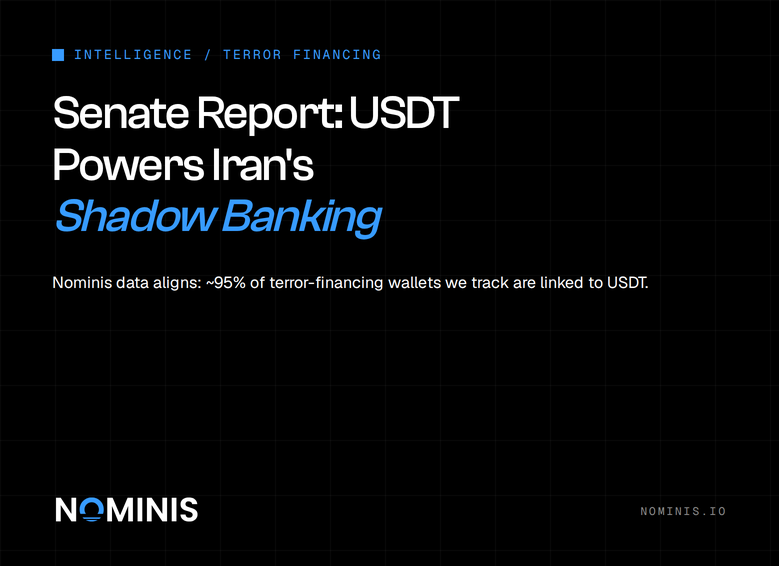
A new US Senate investigation has found that Tether's USDT stablecoin is the primary cryptocurrency behind Iran's sanctions evasion and terror financing. Published on 28 September 2026, Tethered to Terrorism found that 84% of 846 Iran-linked sanctioned wallets transacted almost exclusively in USDT, tracing hundreds of millions of dollars moving between the Iranian regime, Hamas, Hizballah and the Houthis.
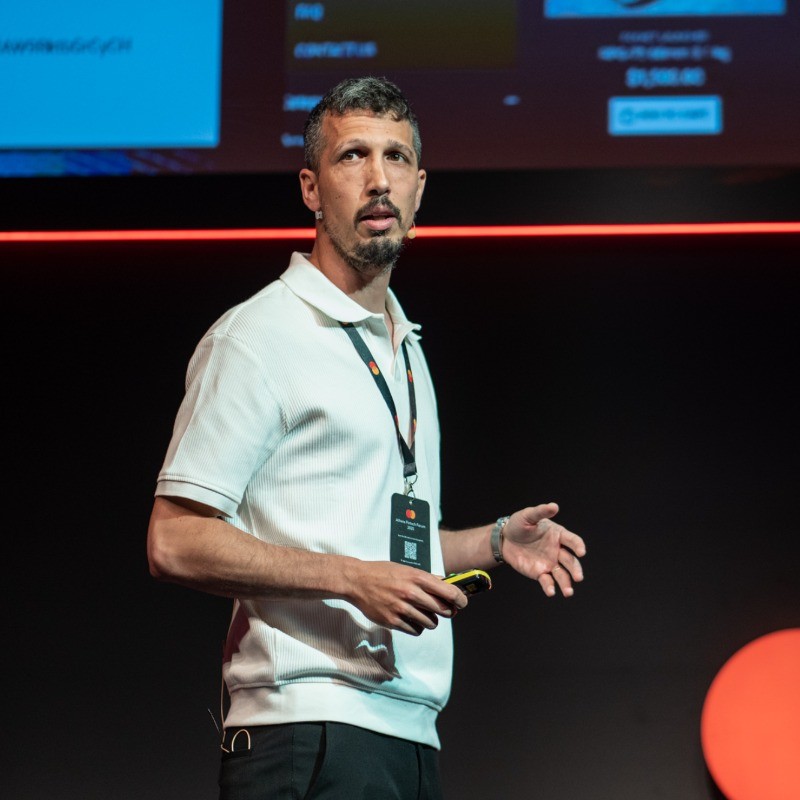
Nominis CEO Snir Levi responds
"The Subcommittee's report puts on the public record what Nominis has been warning about since 2023. USDT has become the settlement currency of choice for Iran's shadow banking network and the proxies it funds.
Nominis works in close proximity to the NBCTF's counter-terror financing efforts, and we have watched this shift happen designation by designation. In 2021, the Hamas wallets named in Israeli seizure orders held mostly Bitcoin and a spread of altcoins. By 2024, nearly every order was dominated by USDT on TRON. We published on it, briefed on it, and flagged the intermediaries behind it. The pattern in the Subcommittee's data matches what we see in our own investigations.
The report's most important finding is also its simplest: freezing wallets after they are designated comes too late. Funds leave in the hours before a listing, and the intermediaries doing the real work, the brokers, cashdesks and relay wallets moving hundreds of millions, are rarely designated at all. Nominis assesses that most compliance teams' exposure to these networks is indirect, sitting one or two hops away and invisible to screening that relies on sanctions lists alone.
Stablecoins are also part of the answer. A centralised issuer can trace and freeze funds in ways that Bitcoin cannot. The priority now is for issuers, exchanges and payment providers to act on network-level intelligence before the designation arrives."
Snir Levi, Founder & CEO, Nominis
What the Senate report found
The Senate Permanent Subcommittee on Investigations (PSI) analysed blockchain data from 846 wallets sanctioned or seized by OFAC and Israel's National Bureau for Counter Terror Financing (NBCTF) between 2021 and 2026.
Among NBCTF-designated wallets, 87% transacted mainly in USDT. Among OFAC designations, the figure was 57%, with most "mixed" wallets also relying heavily on USDT. Bitcoin came a distant second. Circle's USDC barely appeared.
Why Iran relies on USDT
Cut off from SWIFT and the global banking system, Iran needs a way to move dollars across borders. USDT holds its value against a collapsing rial, trades widely on unregulated exchanges, and is easy to buy in hubs like the UAE and Türkiye.
The problem is not confined to high-risk jurisdictions. Nominis previously exposed how IRGC-linked infrastructure moved millions in USDT through London-registered exchanges ZedCex and ZedXion between 2023 and 2025. Zedcex is among the OFAC-designated entities in the Senate's dataset.
How Iran's crypto shadow banking network works
Crypto rarely stands alone in Iran's sanctions evasion. It is usually the final step, turning oil, gold and donations into portable digital dollars.
The Central Bank of Iran. Leaked letters exposed a "National – Tether" scheme to support the rial and oil sales. Linked broker wallets took in around $575 million in three months. OFAC later froze two further CBI wallets holding $344.2 million, a case Nominis examined in its analysis of the $344M USDT freeze.
Oil
Sanctioned Iranian crude is moved through ship-to-ship transfers, dark fleet tankers and falsified cargo documents. Proceeds pass through front companies in the UAE and Hong Kong before OTC brokers convert them into crypto. The Senate report found sanctioned oil brokers Alireza Derakhshan and Arash Estaki Alivand moved $603 million in USDT between 2021 and 2025. Nominis's joint research with INSS, Iran and Hezbollah's Illicit Crypto Operations: The Venezuelan Connection, found Alivand also conducted multi-million-dollar transactions with Hezbollah money exchanger Tawfiq Al-Law. Al-Law is the same financier whose wallets Tether took nine months to freeze.
Gold
The same INSS research traced a parallel Hezbollah pipeline running from Venezuela's Orinoco Mining Arc. Illicitly extracted gold is consolidated through shell companies and smuggled into Brazil, Guyana, Türkiye and the Middle East. Cash proceeds are then converted through OTC brokers, with USDT on TRON the stablecoin of particular relevance, before funds are redistributed to Hezbollah, the IRGC-Quds Force, Hamas and Palestinian Islamic Jihad.
Humanitarian charity fronts
Iran's proxies also raise funds in the open, using humanitarian branding to lower the guard of donors and platforms. The Senate report found Hamas-linked Gaza Now kept fundraising in USDT after OFAC sanctioned it. In a joint investigation, Nominis and Coleven revealed a Hezbollah crypto fundraising network run through an anonymous X account posting humanitarian appeals for Lebanon. Donations were channelled to Wataawanou, a charity widely documented as a Hezbollah front. Among the receiving addresses was a USDT-on-TRON wallet, which Nominis described as an expected finding on the dominant terror financing rail. The donation wallets handled only tens of thousands of dollars, but Nominis assesses the wider network behind them at roughly $90 million.
Shared laundering infrastructure.
The USDT wallets moving Iranian money do not always serve Iran alone. In Tracing Cartel Crypto, Nominis examined a New Mexico case in which the same USDT accounts on TRON laundered Sinaloa Cartel drug proceeds, IRGC-linked funds and money from North Korea's Bybit hack. Tether froze the accounts at investigators' request, and $2.2 million was transferred into FBI custody. Nominis assesses this points to laundering-as-a-service, with networks built to serve any client rather than one.
Hamas, Hezbollah, the Houthis and the shift to USDT on TRON
The Senate report dates the proxies' move to USDT to 2023 and 2024. Nominis has tracked this shift closely, and several wallets in the Senate's dataset were flagged by Nominis before they were designated.
In a previous statement regarding terror groups’ use of gasless wallets, Nominis documented how the NBCTF froze over 143 TRON wallets linked to terrorist groups between July 2021 and October 2023.
When OFAC sanctioned Houthi financial official Sa'id Al-Jamal in December 2024, Nominis had already identified the proxy wallets and their links to the IRGC and Hezbollah. And when OFAC sanctioned Hamas financier Zaid Al-Jebouri in July 2026, Nominis had flagged his TRON wallet as critical risk as early as August 2024, almost two years before designation.
Tether's freezing failures
PSI found Tether froze no NBCTF-designated wallets between 2021 and October 2023. In the Al-Law case, a nine-month delay let $34.6 million move after designation. CBI wallets publicly posted by sanctioned money launderer Babak Zanjani remain unfrozen.
What this means for crypto compliance teams
Sanctions list screening alone will miss most Iranian exposure. The brokers, cashdesks and shared laundering accounts moving the money are rarely designated, and funds often leave before a wallet is listed. Networks also spread across chains, so screening that stops at the obvious rails leaves gaps.
The Al-Jamal and Al-Jebouri cases show the alternative: wallets identified months or years before they reach the SDN List. As Nominis has noted, wallets previously identified through its research have subsequently been formally designated by authorities.
Nominis provides blockchain intelligence that helps compliance teams identify sanctions and terror financing exposure before it reaches the designation list.
All research content and accompanying reports are provided for informational purposes only and should not be relied upon as professional advice. Accessing these materials does not create any professional relationship or duty of care. Readers are encouraged to consult appropriately qualified professionals for guidance. We uphold the highest standards of accuracy in all the information we provide. For any questions or feedback, please contact us at contact@nominis.io.