A groundbreaking investigation published today by The Washington Post reveals that Iran’s Islamic Revolutionary Guard Corps, a U.S. designated Foreign Terrorist Organization, has been exploiting the global cryptocurrency ecosystem to move nearly $150 million in funds through two London-registered exchanges, ZedCex and ZedXion, between 2023 and 2025, shedding fresh light on how sanctioned entities are using digital assets to evade financial controls.
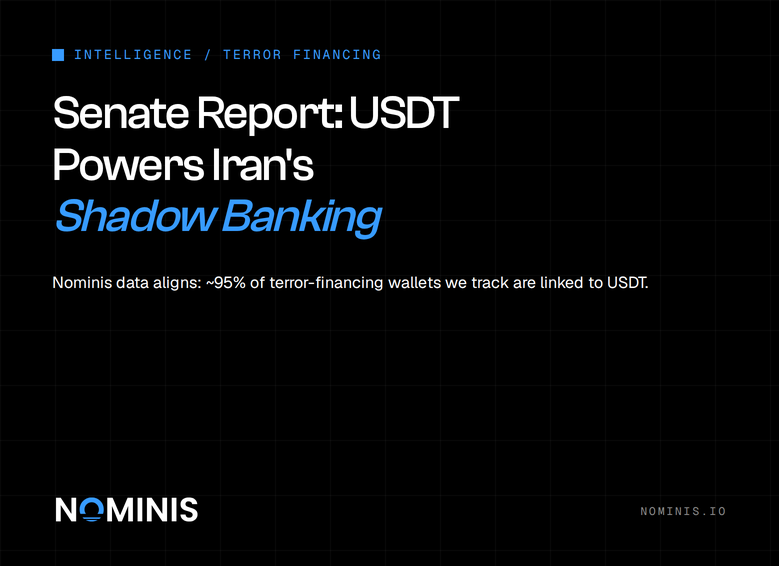
The report features research that Nominis independently corroborated and verified, shows that wallets linked to the IRGC routed massive volumes of the USDT stablecoin via the TRON blockchain into accounts on exchanges acting as crypto hubs, including a London-based platform that has emerged as a key node in masking the origin and destination of terror financing flows.
Our Investigation
NOMINIS’ on-chain investigation identified and traced wallet addresses previously tied to IRGC affiliates and mapped hundreds of millions in transactions that converged on the London exchange’s infrastructure long before TRM Labs published its findings. The analysis demonstrated how these flows expanded over time, intensifying in 2024 and 2025, and highlighted patterns consistent with sophisticated laundering techniques involving multiple intermediaries and offshore entities.
According to the Washington Post’s reporting, the IRGC’s use of these crypto rails illustrates a deeper shift in the tactics of sanctioned actors, who are increasingly treating blockchain networks as functional substitutes for traditional shadow banking systems. The Post story notes that wallet transfers associated with the IRGC accounted for a majority of trading volume on the two targeted exchanges during key periods, exposing vulnerabilities in anti-money-laundering controls and the limits of existing regulatory frameworks.
Experts cited in the report caution that cryptocurrency’s pseudonymous nature can obscure the flow of funds while still offering unparalleled transparency for investigators who know where to look. Nominis’ contribution underscores the value of advanced on-chain analytics, including behavioral and cross-chain pattern detection, in unmasking complex transaction networks used by state-linked entities looking to bypass sanctions.
The Washington Post’s investigation highlights not only the scale of the financial channels that the IRGC has leveraged but also the critical role that blockchain surveillance and forensic platforms play in exposing illicit finance on public ledgers. As global regulators and enforcement agencies recalibrate their strategies to address blockchain-enabled sanctions evasion, on-chain insight from firms like Nominis is proving vital in tracing and attributing flows that would otherwise remain hidden.
The story marks a significant moment in the ongoing effort to hold accountable those who exploit digital finance for malign purposes and reinforces the importance of real-time analysis to defend the integrity of the global financial system.
All research content and accompanying reports are provided for informational purposes only and should not be relied upon as professional advice. Accessing these materials does not create any professional relationship or duty of care. Readers are encouraged to consult appropriately qualified professionals for guidance. We uphold the highest standards of accuracy in all the information we provide. For any questions or feedback, please contact us at contact@nominis.io.