By the Nominis Intelligence Unit. Published 7 November 2026.
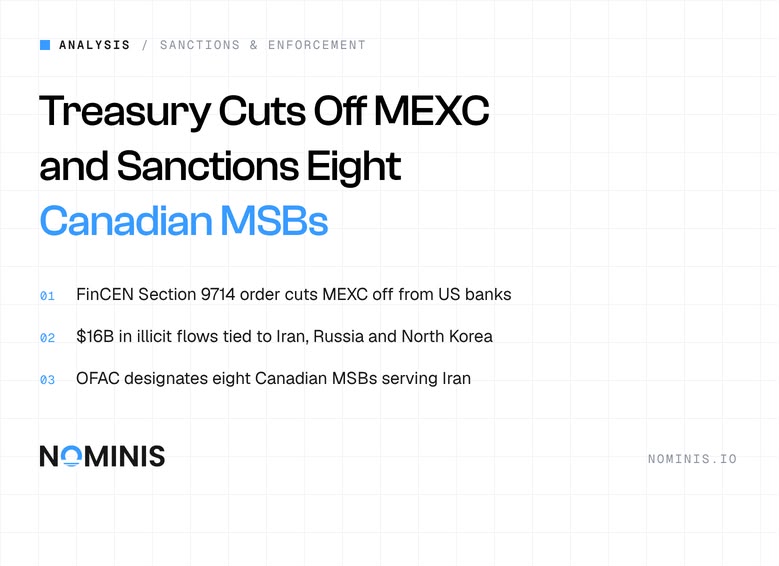
In short: On 6 November 2026, the US Treasury took two actions under Operation Economic Outcast. FinCEN issued a section 9714 order that cuts crypto exchange MEXC Global off from the US financial system, citing at least $16 billion in illicit transactions linked to Iran, North Korea and Russia. OFAC designated eight Canadian money services businesses that converted Iranian rials into crypto for the Iranian regime, the IRGC and sanctioned Iranian exchanges. Compliance teams should update screening for all eight entities and their trading names, and map MEXC exposure before the order takes effect.
Key takeaways
- FinCEN's order under section 9714(a) of the Combating Russian Money Laundering Act bars US financial institutions from any transmittal of funds to or from MEXC Global, one of the world's 20 largest crypto exchanges.
- Treasury says MEXC Global facilitated at least $16 billion in illicit transactions between May 2021 and May 2026, linked to Russian, Iranian and North Korean sanctions evasion, ransomware, scams and darknet markets.
- OFAC designated eight Canadian money services businesses (MSBs) in Ontario and British Columbia under Executive Order 13902 for operating in Iran's digital asset sector.
- Several of the Canadian MSBs also laundered drug proceeds for sanctioned Canadian trafficker Ryan Wedding.
- Both actions target the intermediaries that connect sanctioned actors to the wider crypto economy, rather than the sanctioned actors themselves.
What happened on 6 November 2026
Treasury took two coordinated actions as part of Operation Economic Outcast, the campaign it launched in August 2026 to cut off the economic lifelines of the Iranian regime and the Islamic Revolutionary Guard Corps (IRGC), including its use of cryptocurrency to evade sanctions.
The first was a FinCEN order against MEXC Global, a Seychelles-incorporated exchange. The second was a set of OFAC designations against eight Canadian MSBs that exchange Iranian rials and other currencies for digital assets. The OFAC action was coordinated with FinCEN, with FINTRAC, Canada's financial intelligence unit, and with the Drug Enforcement Administration.
Taken together, the two actions move Operation Economic Outcast beyond Iranian exchanges themselves. Earlier in 2026, Treasury designated Nobitex, Wallex, Bitpin and Ramzinex (2 June) and Aban Tether Exchange and Shelbit (7 August). This week it went after the offshore exchange and the foreign cash-to-crypto desks that connect those platforms, and the people using them, to the rest of the market.
Why did FinCEN cut off MEXC Global?
MEXC Global was founded in 2018. According to Treasury, as of September 2026 it processed more than $1 billion in daily transactions, held around $5 billion in reserves and offered access to more than 3,000 cryptocurrencies and tokenised assets. Its terms prohibit users in Iran and North Korea, but Treasury says severe weaknesses in its AML controls allowed it to serve customers in exactly those jurisdictions.
Treasury's findings for the period between May 2021 and May 2026 include:
- At least $16 billion in funds connected to sanctions evasion, cybercrime and other illicit activity.
- Nearly $1.5 billion linked to Russian sanctions evasion, including $232 million in direct transactions with US-, EU- and UK-sanctioned entities.
- Continued activity with Garantex and its successor Grinex as recently as June 2026, more than four years after OFAC designated Garantex in April 2022.
- At least $26 million benefitting the sanctioned A7 network, and almost $200 million in transactions connected to A7A5, the network's ruble-backed stablecoin.
- Around $1 billion in direct transactions with more than 40 identified Iranian crypto exchanges, some of them sanctioned.
- Around $22 million in transactions for the Central Bank of Iran and the IRGC and its Qods Force.
The order prohibits US financial institutions from sending funds to or receiving funds from MEXC Global. It takes effect 30 days after publication in the Federal Register, and violations can bring civil or criminal penalties. It does not change existing Bank Secrecy Act obligations, including suspicious activity reporting, or OFAC sanctions obligations.
MEXC said it is reviewing the order with its legal and compliance teams, that it is operating normally and that user assets remain secure. It also said it has started an independent review of its AML and sanctions controls.
Which Canadian MSBs did OFAC sanction?
OFAC designated the eight businesses under Executive Order 13902, which targets the Iranian digital asset sector. Treasury describes Canada as home to hundreds of MSBs that move funds into and out of Iran, either through cash-based value transfer or by converting cash into digital assets. It also notes that several of the designated firms have changed their names and addresses to avoid detection, and that all of them remain operational.
The eight designated entities, listed by trading name, and what Treasury alleges against each:
- Million Exchange (Diverse Trade Inc, Ontario). Sent hundreds of thousands of dollars to IRGC or terrorism-linked addresses, and laundered drug proceeds, including for Ryan Wedding.
- Amin Exchange (1380079 BC Limited, British Columbia, and its closely associated affiliate Top PC Technician Inc, Ontario). Received hundreds of thousands of dollars from Shelbit, and laundered millions in drug proceeds in Toronto, Vancouver and Montreal, including for Wedding.
- NIA Nations (NIA Nations Currency Ltd, British Columbia). Transacted with IRGC-linked addresses and with Nobitex, Wallex, Ramzinex and Bitpin.
- Farah Exchange (2397639 Ontario Ltd, Ontario). Transacted with Shelbit and Wallex, sent funds to terrorism-linked addresses and sent millions to Wedding-linked addresses.
- CCC (CCC Inc, Ontario). Received hundreds of thousands of dollars from terrorism-linked addresses, and claims to be licensed in Iran and Canada.
- Cryptoyal (B Galaxy Inc, Ontario). Shares a location with CCC Inc and advertises unlimited crypto in exchange for Iranian currency.
- Darvish Exchange (Ontario). Transacted with Nobitex, Wallex, Aban Tether Exchange and Shelbit.
The Ryan Wedding connection adds a second layer. Treasury says Wedding, a former Olympic snowboarder who was apprehended in January 2026, used couriers to deliver bulk cash from drug sales to exchange businesses in the Vancouver and Toronto areas, which converted it into crypto and sent it abroad. The same desks that served Iranian sanctions evasion also served narcotics money laundering.
Why these actions matter for crypto compliance
Section 9714 is a powerful tool against exchanges. MEXC Global has not been added to the SDN list. Instead, FinCEN has used a transmittal ban that cuts the exchange off from US banks and payment providers. For an offshore exchange, that means losing direct access to dollar rails and, in practice, to many of the banking and payment partners that depend on them. Nominis assesses that exchanges serving high-risk flows should now expect section 9714 to sit alongside OFAC designations as a standard Treasury response.
The intermediaries are now the target. The Iranian exchanges designated earlier in the year were already sanctioned. What kept value moving was the layer around them: an offshore exchange that kept processing their flows, and cash-to-crypto desks in a G7 country that converted rials into digital assets. The same pattern runs through the Russian side of the MEXC findings, where Garantex, Grinex and A7A5 continued to reach the market through a large global venue. We set out how these networks connect in our research on Russia's crypto sanctions ecosystem, and covered the October A7 designation in our October monthly report.
Rebranding is part of the evasion playbook. Treasury notes that several of the Canadian MSBs changed names and addresses, and that two of them operated under the same Amin Exchange brand in different provinces. Screening that relies only on legal entity names will miss trading names, new branches and replacement entities. Nominis assesses that the same operators are likely to reappear under new names within months.
Small transfers carry the terrorism risk. Several of the Canadian entities sent or received amounts in the hundreds of thousands of dollars to and from IRGC- or terrorism-linked addresses. These sums are small next to MEXC's $16 billion, and they rarely trigger value-based alerts. As we have argued in Stablecoins: the New Front Line in Terror Finance, catching them depends on attribution of the wallets involved.
What compliance teams should do now
- Update sanctions screening. Add the eight Canadian entities, including every trading name (Million Exchange, Amin Exchange, NIA Nations, Farah Exchange, Cryptoyal, Darvish Exchange), and the identifiers in OFAC's 6 November listing.
- Map your MEXC exposure before the order takes effect. US financial institutions have until 30 days after Federal Register publication. Identify deposit and withdrawal flows to and from MEXC now, including indirect flows through intermediaries.
- Expect questions from banking partners. Non-US VASPs with US banking or payment relationships should be ready to show how they identify and handle MEXC-linked flows.
- Look beyond direct exposure. Funds from the designated MSBs and the Iranian exchanges they served will often arrive after several hops. Screening should cover nested and indirect exposure, not only first-hop counterparties.
- Run a lookback. Review historical transactions with the designated entities and with MEXC, and file suspicious activity reports where required. Neither action changes existing reporting obligations.
Frequently asked questions
Has MEXC been sanctioned by OFAC?
No. MEXC Global has not been added to the SDN list. FinCEN issued an order under section 9714(a) of the Combating Russian Money Laundering Act, which prohibits US financial institutions from transmitting funds to or from MEXC Global. It is a separate tool from an OFAC designation.
What is a section 9714 order?
Section 9714 of the Combating Russian Money Laundering Act lets Treasury impose special measures on a foreign financial institution it finds to be of primary money laundering concern in connection with Russian illicit finance. In MEXC's case, the measure is a ban on US financial institutions sending or receiving funds involving the exchange.
When does the MEXC order take effect?
The order takes effect 30 days after it is published in the Federal Register.
Is MEXC still operating?
MEXC said after the order that it is operating normally, that user assets remain secure and that it has started an independent review of its AML and sanctions controls.
Which Canadian MSBs were sanctioned?
Diverse Trade Inc (Million Exchange), 1380079 BC Limited and Top PC Technician Inc (both Amin Exchange), NIA Nations Currency Ltd, 2397639 Ontario Ltd (Farah Exchange), CCC Inc, B Galaxy Inc (Cryptoyal) and Darvish Exchange.
What is Operation Economic Outcast?
It is a US Treasury campaign launched in August 2026 to cut off the economic lifelines of the Iranian regime and the IRGC, including their use of digital assets to evade sanctions.
Sources
- US Treasury: Operation Economic Outcast Severs MEXC Global's Access to the U.S. Financial System (6 November 2026)
- US Treasury: Operation Economic Outcast Sanctions Eight Canadian Money Services Businesses Enabling Iranian Regime (6 November 2026)
- FinCEN: Section 9714 order regarding MEXC Global
- OFAC: Recent Actions, 6 November 2026
Stay ahead of sanctions exposure
Nominis provides wallet screening, transaction monitoring and investigations that combine on-chain attribution with off-chain intelligence, helping compliance teams identify exposure to sanctioned exchanges, MSBs and their rebranded successors. Talk to our team to find out how we can help.
All research content and accompanying reports are provided for informational purposes only and should not be relied upon as professional advice. Accessing these materials does not create any professional relationship or duty of care. Readers are encouraged to consult appropriately qualified professionals for guidance. We uphold the highest standards of accuracy in all the information we provide. For any questions or feedback, please contact us at contact@nominis.io.