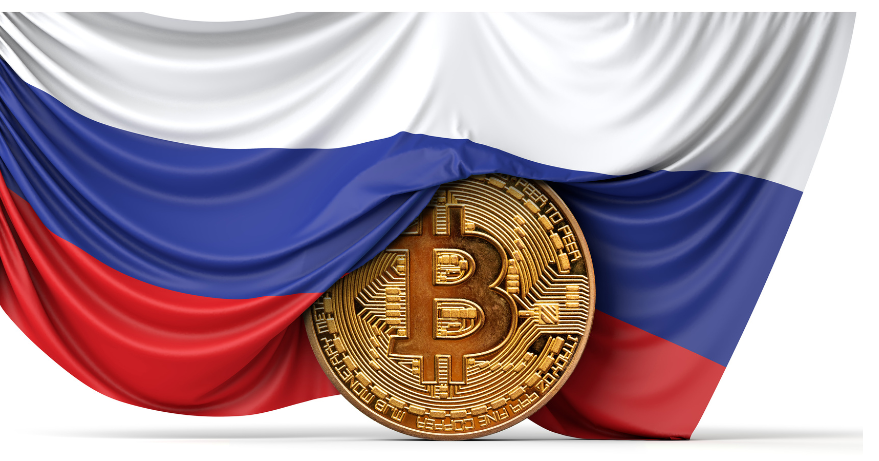
Russia-linked cryptocurrency activity has developed beyond individual users and informal trading into a wider ecosystem involving cryptocurrency exchanges, stablecoins, payment companies, brokers and financial intermediaries. The ecosystem has become increasingly relevant to cross-border payments following the introduction of extensive Western sanctions after Russia's invasion of Ukraine in 2022.
Cryptocurrency provides an additional mechanism for transferring value across borders without relying entirely on traditional correspondent banking. Russian-linked actors have used established cryptocurrencies such as Bitcoin and Tether (USDT), alongside newer ruble-linked digital assets such as A7A5. However, the available evidence does not indicate a single centralised Russian cryptocurrency system. Instead, the activity consists of interconnected companies, financial institutions, exchanges, wallets and intermediaries operating across several jurisdictions.
Actors and Infrastructure
Companies and Financial Service Providers
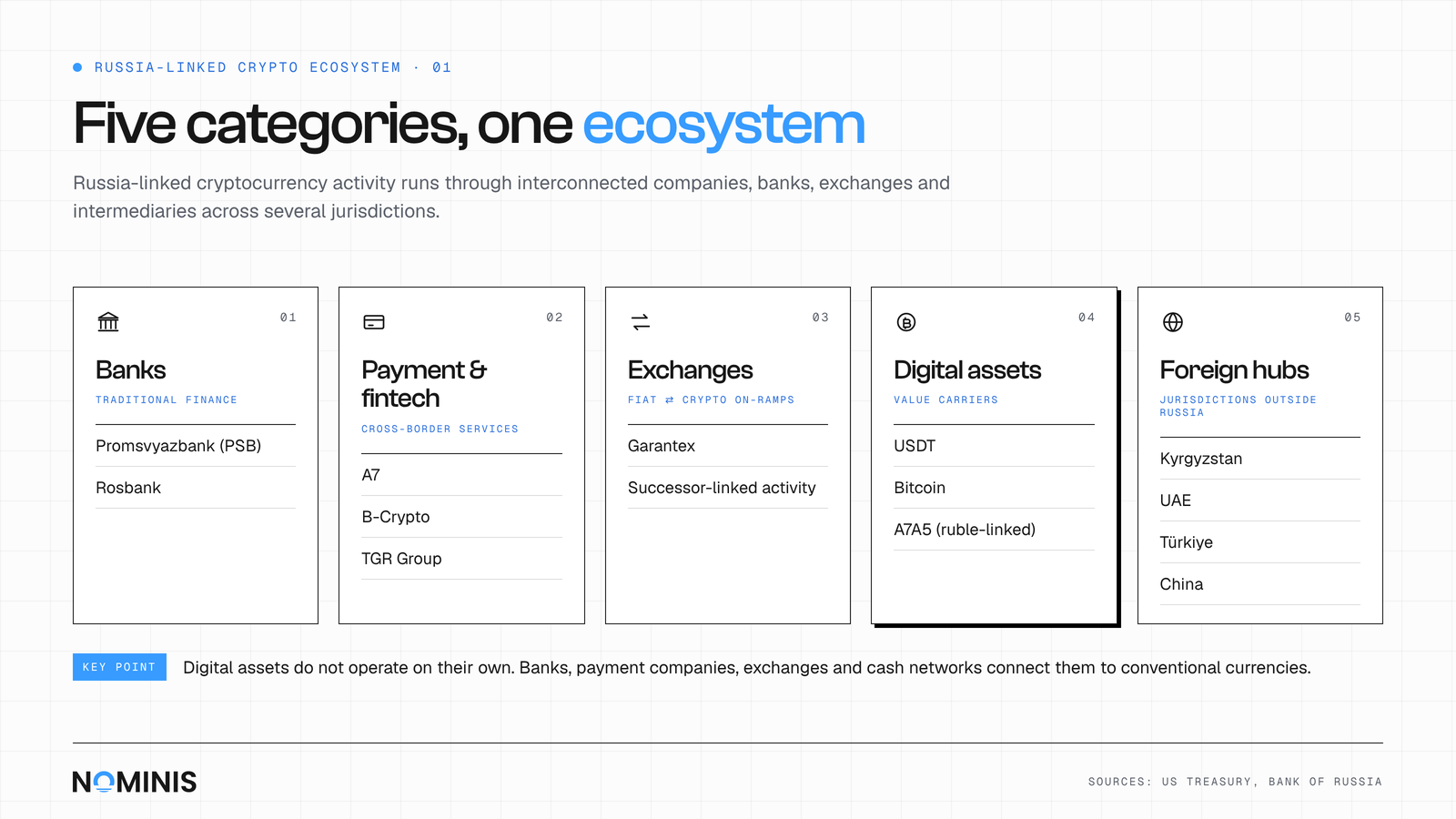
- A7 – A Russian-linked financial company associated with cross-border payment services and the A7A5 ruble-backed stablecoin.
- Garantex – A Russia-based cryptocurrency exchange sanctioned by the United States for its role in facilitating illicit cryptocurrency transactions. Its infrastructure and successor-linked activity have subsequently appeared in investigations outside Russia.
- TGR Group – An international network of companies involved in cryptocurrency, cash and financial services. The United States Treasury identified the network as part of Russia-linked illicit financial activity.
- B-Crypto – A Russian fintech company associated with the use of digital assets for cross-border settlements.
Banks and Financial Institutions
- Promsvyazbank (PSB) – A Russian bank subject to extensive Western sanctions and associated with Russian state and defence-sector financial activity. It has also been connected to the development of alternative payment infrastructure.
- Rosbank – A Russian bank that has been involved in experiments involving cryptocurrency and digital-asset-based cross-border settlements.
Financial Infrastructure
The wider ecosystem includes blockchain networks, cryptocurrency wallets, stablecoins and alternative payment mechanisms. Stablecoins such as USDT are designed to maintain a relatively stable value against a reference currency, while A7A5 is designed to maintain a value linked to the Russian ruble.
These technologies do not operate independently of the traditional financial system. Cryptocurrency exchanges, banks, payment companies and cash networks can connect digital assets to conventional currencies and provide the infrastructure necessary to move value between the two.
Drivers of Russian Interest
Western sanctions introduced following the 2022 invasion of Ukraine significantly increased the pressure on Russian banks and companies to find alternative methods for conducting international transactions. Restrictions on correspondent banking, financial institutions and access to Western payment infrastructure increased the importance of alternative payment arrangements.
Russia subsequently expanded efforts to develop alternative channels for international trade and payments, including the use of national currencies, alternative financial messaging systems and digital assets.
The Bank of Russia has supported the development of digital assets for certain cross-border settlements. In 2024, Russian legislation established an experimental framework allowing selected businesses to use cryptocurrency for international trade settlements.
This does not indicate that cryptocurrency has replaced Russia's traditional banking system. Rather, digital assets form part of a broader Russian effort to diversify cross-border payment mechanisms and reduce dependence on Western financial infrastructure.
Important Jurisdictions Outside Russia
Kyrgyzstan
Kyrgyzstan appears particularly significant to the emerging Russia-linked digital-asset ecosystem.
- The A7A5 ruble-backed stablecoin is issued through a company registered in Kyrgyzstan.
- Cryptocurrency activity associated with entities linked to the former Garantex ecosystem has also appeared in Kyrgyzstan.
- The country's financial and corporate infrastructure therefore provides an important connection between Russian-linked digital assets and international markets.
United Arab Emirates
The UAE appears in investigations into Russia-linked cryptocurrency and financial networks and provides an important international financial and trading environment. Its significance is broader than cryptocurrency alone, with Russian-linked businesses using the UAE for financial, commercial and treasury activities.
Türkiye
Türkiye has appeared in investigations into Russia-linked financial activity and provides another connection between Russian businesses, cryptocurrency markets and international financial networks. Its role should therefore be viewed as part of the wider cross-border ecosystem rather than as evidence of a dedicated Russian cryptocurrency hub.
China
China is relevant to the ecosystem primarily through Russia-China trade and financial relationships. Chinese financial infrastructure and the use of the Chinese yuan provide Russia with alternatives to Western currencies and payment channels. A7's foreign treasury operations have also been linked to China.
Analytical Assessment
- Cryptocurrency has become an additional component of Russia's cross-border financial infrastructure. Its importance increased as sanctions and restrictions made some traditional international payment channels more difficult to use.
- The ecosystem is multinational rather than centralised. Russia-linked cryptocurrency activity involves companies, exchanges, banks and intermediaries operating across Russia and foreign jurisdictions, including Kyrgyzstan, the UAE, Türkiye and China.
- Cryptocurrency is complementary to, rather than a replacement for, traditional finance. Digital assets can provide an alternative mechanism for transferring and settling value internationally, but they remain connected to banks, payment companies, exchanges and conventional currencies.
- The evidence supports identifying a Russia-linked cryptocurrency ecosystem, but not a single unified system. The network is better understood as a collection of interconnected financial and digital-asset services that can facilitate cross-border payments, settlement and access to alternative financial channels.
All research content and accompanying reports are provided for informational purposes only and should not be relied upon as professional advice. Accessing these materials does not create any professional relationship or duty of care. Readers are encouraged to consult appropriately qualified professionals for guidance. We uphold the highest standards of accuracy in all the information we provide. For any questions or feedback, please contact us at contact@nominis.io.