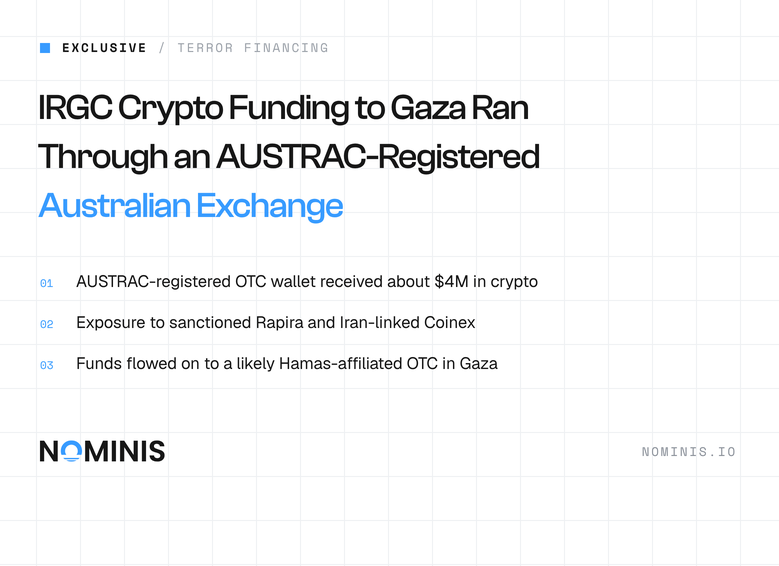
TLDR: Using our human intelligence capabilities, Nominis uncovered an Australian branch of an Iran-based OTC entity with direct exposure to sanctioned Russian and Iranian cryptocurrency exchanges, as well as IRGC terror infrastructure. Furthermore, this Australian branch served as a conduit for the flow of cryptocurrency from Iran to Gaza, demonstrating the IRGC’s global reach and continued illicit activity within Australia.
These findings are part of a wider, ongoing Nominis investigation into the global extent of Iran’s illicit cryptocurrency networks.
How HUMINT Uncovered an AUSTRAC-Registered Iranian OTC
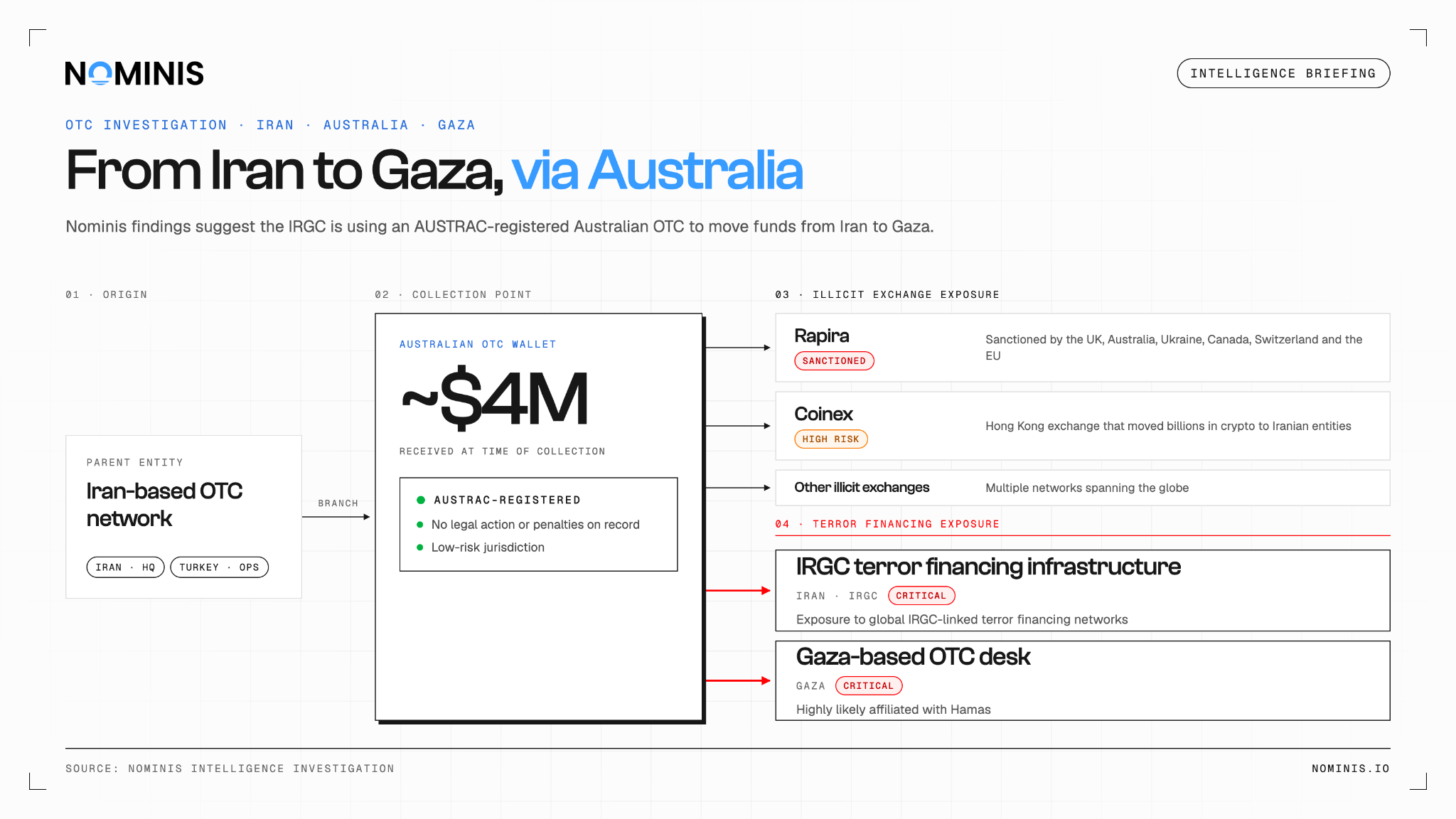
As part of routine investigations, Nominis established contact and ultimately received the wallet address of an OTC entity based in Australia that serves as a branch of a larger entity based in Iran that also operates in Turkey. The wallet had received approximately 4 million US dollars in crypto assets at the time of collection. This OTC is formally registered with the Australian Transaction Reports and Analysis Centre (AUSTRAC), Australia’s national anti-money laundering and counter-terror financing regulator, as a legal entity, and it does not appear to have faced legal action or financial penalties throughout the period of its registration.
Exposure to Sanctioned Exchanges: Rapira and Coinex
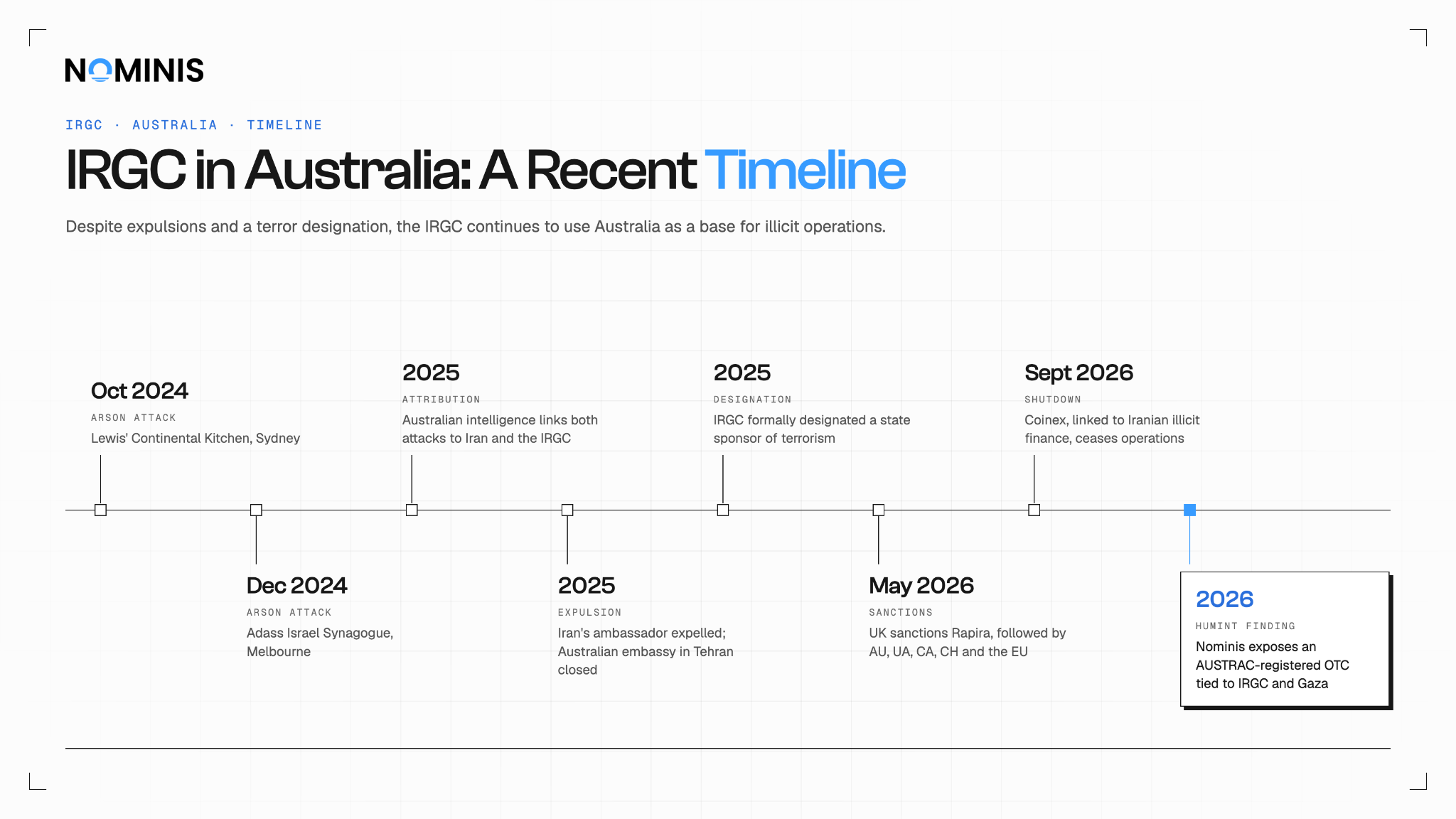
However, further investigation revealed that this Australian OTC had exposure to multiple illicit exchanges and networks spanning across the globe. Among the most notorious is Rapira, an exchange formally registered in the Republic of Georgia, though the Georgian Ministry of Finance alleges that it maintains no assets or offices in Georgia, and instead operates from Moscow. Rapira has been tied to the Russian financial services sector, and was sanctioned by the United Kingdom in May 2026 for its involvement in “destabilising Ukraine or undermining or threatening the territorial integrity, sovereignty or independence of Ukraine.” It was subsequently sanctioned in recent months by Australia, Ukraine, Canada, Switzerland, and the European Union.
The OTC also had exposure to Coinex, a Hong Kong-based exchange that ceased operations in September 2026. According to Nominis’ Head of Intelligence, Coinex, while never officially sanctioned, had extensive exposure to Iranian illicit finance and facilitated the transfer of billions of dollars in crypto to Iranian entities.
From Iran to Gaza: Links to IRGC and Hamas Terror Financing
The most surprising insights from Nominis’ investigation are the Australian OTC’s exposure to global IRGC terror financing infrastructure and a Gaza-based OTC highly likely to be affiliated with Hamas. This suggests that the IRGC is using the Australian OTC as an intermediary to facilitate the transfer of money from Iran to Gaza and obfuscate its terror financing networks behind an entity operating in a jurisdiction deemed low-risk, where the exchange is less likely to face scrutiny.
The IRGC’s Presence in Australia: Diasporic Communities, Arson Attacks and Terror Designation
The Islamic Republic and Australia have maintained diplomatic relations since the 1979 Iranian Revolution, though relations between the two nations strained severely in 2025, when Australian intelligence services assessed that the Iranian government and the Islamic Revolutionary Guard Corps (IRGC) had orchestrated two arson attacks against Jewish-owned establishments in Australia: Lewis' Continental Kitchen in Sydney in October 2024 and the Adass Israel Synagogue in Melbourne in December 2024.
As of 2021, approximately 71,000 people born in Iran live in Australia, most of whom arrived in the twenty-first century. Australia’s Iranian immigrant population is highly educated, professional, and proficient in English. While a majority of Iranian-Australians do not identify as Muslim, some elements of the community are more aligned with the Iranian regime, including a small number of Shia mosques that hosted vigils for the late Supreme Leader Ali Khamenei.
A parliamentary investigation also found that members of the Iranian-Australian community had been subject to surveillance, intimidation, and harassment by the IRGC. For example, the IRGC was found to have monitored Iranian-Australians who participated in protests or publicly criticized the Iranian government, often attempting to silence them by sending threatening messages to their family members in Iran.
In response to these discoveries, the government of Prime Minister Anthony Albanese expelled Iran’s ambassador to Australia, along with three other embassy staff, whilst concurrently shuttering the Australian embassy in Tehran. Additionally, Albanese’s government formally designated the IRGC as a state sponsor of terrorism. This diplomatic crisis revealed the IRGC’s operational capacity in Australia and its willingness to pursue terror-related objectives far beyond Iran’s borders.
The IRGC’s Use of Cryptocurrency to Evade Sanctions
Part of Iran’s broader strategy of sanctions evasion, the exchange of cryptocurrency has become a staple of finance among both government and civilian entities. The regime has long cultivated and embedded itself in Iranian crypto networks, including Nobitex, Iran’s largest exchange. Cryptocurrency exchanges allow Iran to evade sanctions by bypassing regulated banking networks, and the lack of identity verification allows for limited traceability in illicit activity. Crypto has served multiple evolving purposes for Iran, helping stabilize the rial, preserve government assets during war and internet shutdowns, and fund militias and terrorist groups elsewhere in the Middle East.
Previous Nominis investigations have demonstrated a history of Australian crypto exchanges being used as transit points for IRGC-linked services to process and redistribute funds beyond Iran’s borders.
Nominis Assessment
Nominis’s investigation reveals that despite the Albanese government’s efforts to stymie Iranian activity in Australia, the IRGC continues to use Australia as a base to further its illicit operations around the world. It also highlights the intercontinental reach of the IRGC’s networks, in which assets in third countries far from Iran can be used as intermediaries to advance Iran’s interests in its own backyard. That such operations can be facilitated by a legally registered entity under the purview of AUSTRAC conveys the urgent need for greater due diligence from regulators in Australia and throughout the world.
This case is not isolated, and further work from Nominis will continue to unveil the global scale of the IRGC’s evolving cryptocurrency exchange networks.
Furthermore, this investigation underscores the utility of HUMINT, as on-chain analysis alone would not have brought this Australian entity to light. This investigation also would not have been possible without Nominis’ intelligence tools that allow for multi-hop investigations. Such tools are indispensable in uncovering indirect relationships between disparate wallets and entities in a quickly evolving and globalized crypto landscape.
Nominis integrates human intelligence with on-chain analysis to identify such links before they begin to impede compliance. Through wallet screening, transaction monitoring, and forensic investigations, Nomins helps compliance teams be first to flag and first to know.
Talk to our team to find out more.
All research content and accompanying reports are provided for informational purposes only and should not be relied upon as professional advice. Accessing these materials does not create any professional relationship or duty of care. Readers are encouraged to consult appropriately qualified professionals for guidance. We uphold the highest standards of accuracy in all the information we provide. For any questions or feedback, please contact us at contact@nominis.io.