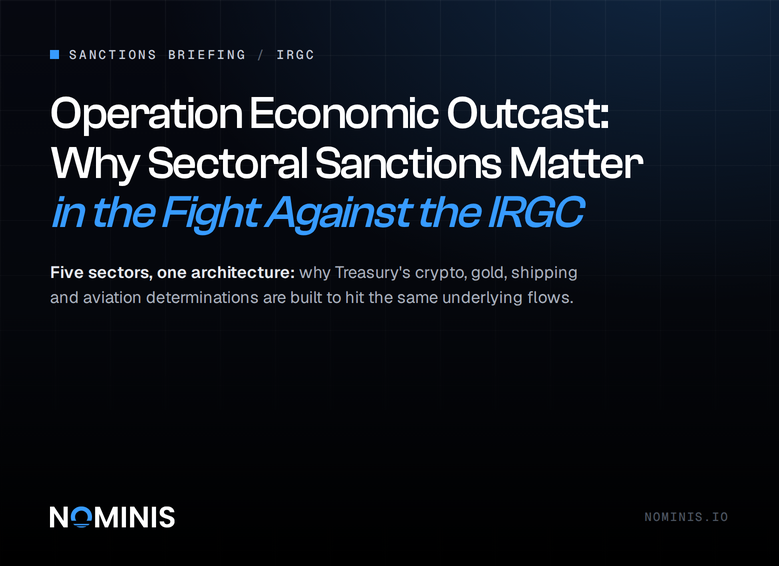
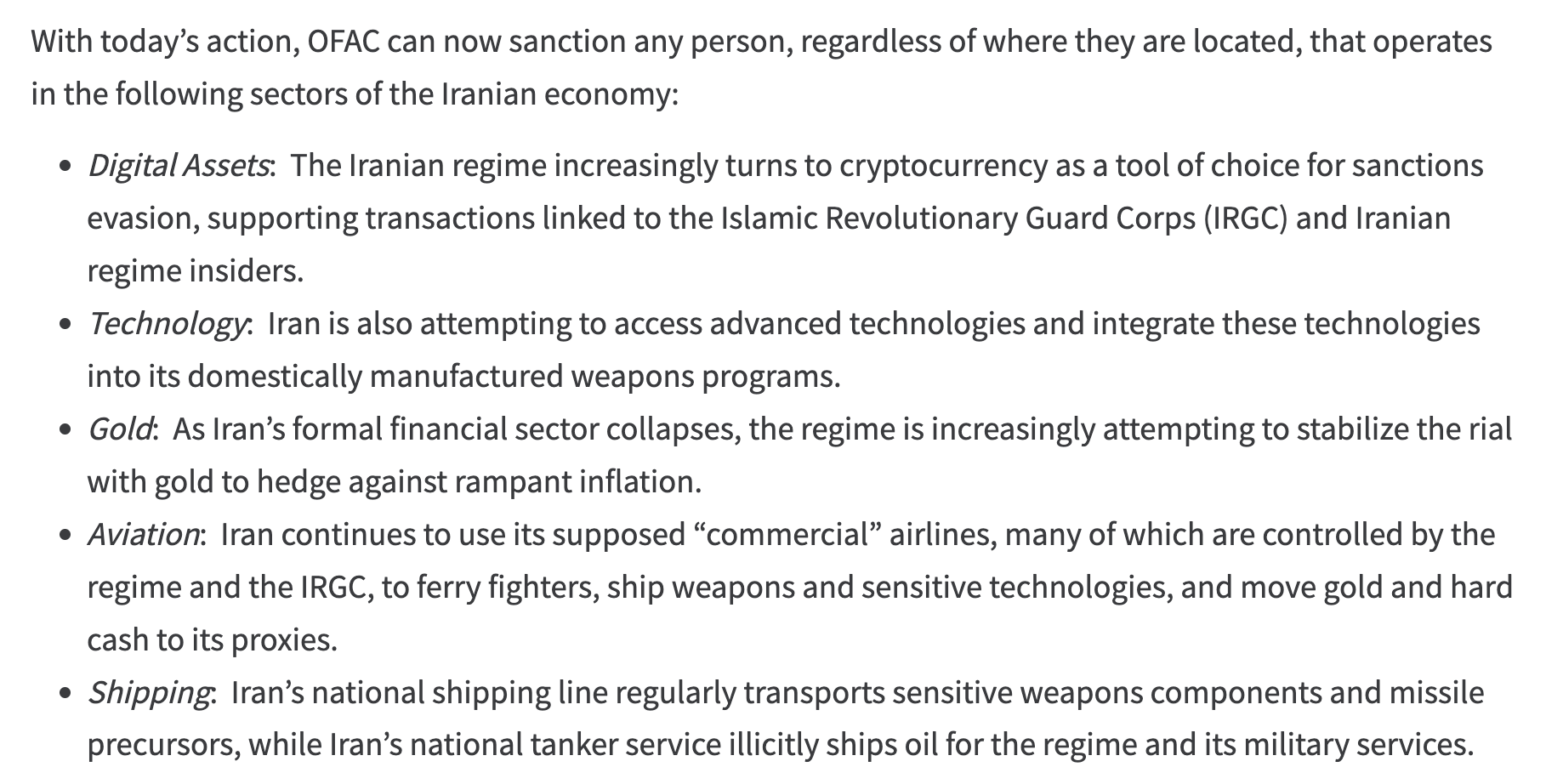
On 24 August 2026, The US Treasury launched Operation Economic Outcast, describing it as an "economic D-Day" against Iran and the IRGC, and Nominis welcomed the move, particularly the decision to issue sectoral determinations covering digital assets, technology, gold, aviation and shipping together. This reflects a point we have been making for a while: the IRGC is so highly dependent on crypto as a method to circumvent sanctions evasion, it cannot be tackled in isolation from the rest of the regime’s financial architecture.
The Significance of Crypto in IRGC Sanctions
Iran’s evasion architecture has simply never relied on a single channel. The Treasury’s designations, as well as our own previous research, makes this clear; for example, national airlines are used to move gold and hard cash, alongside IRGC fighters and weapons. Meanwhile, the rial is propped up through gold accumulation as the traditional financial sector collapses, and global efforts by Iran’s proxy bodies keeps oil revenue flowing back to the regime, despite years of sanctions pressure.
Crypto sits inside each of these processes as often as it sits beside them, functioning as a settlement layer for gold sales, a conversion point for oil proceeds, or simply a transfer mechanism once funds reach a broker or exchange, which is why treating the five sectors as interconnected, rather than as five separate lists, gives the more accurate picture and the one enforcement genuinely needs to work from.
This is consistent with our findings from our joint research with the INSS, published last month. We examined how Iran and Hezbollah convert Venezuelan gold and Iranian oil proceeds into cryptocurrency before redistributing funds to the IRGC-Quds Force and affiliated networks, and both pipelines identified in that research follow the same underlying logic Treasury is now targeting directly: physical commodity, layered intermediaries, conversion into stablecoins (chiefly USDT on TRON), and redistribution.
Today's sectoral determinations also build on Treasury's June designation of Nobitex and other Iranian exchanges, which had already established that digital asset platforms were functioning as regime infrastructure rather than as incidental tools; today's determination goes further still, making that exposure a standing feature of the sanctions regime rather than a one-off designation.
What Do Successful Sanctions Look Like?
Additional designations, at the end of the day, achieve very little without sustained enforcement against the facilitators and conversion infrastructure sitting behind them. Operation Economic Outcast aims to target this issue, though whether it holds will depend on how consistently it is enforced against the third-country facilitators who make each of these five sectors function.
On the digital asset designations specifically, one detail from today's SDN update is worth noting for accuracy. Among the updated entry for Behzad Mesri, an Iranian hacker, OFAC lists several ETH addresses as alternate digital currency addresses, including 0x6…9C0 and 0xA…F6f. Both of these addresses are publicly documented BIP39 test vectors, generated at derivation indices 1 and 5 from the well known "abandon abandon... about" test mnemonic that ships in numerous open-source wallet libraries and tutorials, and the private keys behind them are consequently public knowledge to any developer who has run that standard example.
This does not affect the substance of today's designation, but it is a useful reminder that not every digital currency address listed against a sanctioned individual necessarily functions as an exclusively controlled wallet.
Full information regarding the sanctioning can be found in the Treasury’s Press Release here.
All research content and accompanying reports are provided for informational purposes only and should not be relied upon as professional advice. Accessing these materials does not create any professional relationship or duty of care. Readers are encouraged to consult appropriately qualified professionals for guidance. We uphold the highest standards of accuracy in all the information we provide. For any questions or feedback, please contact us.