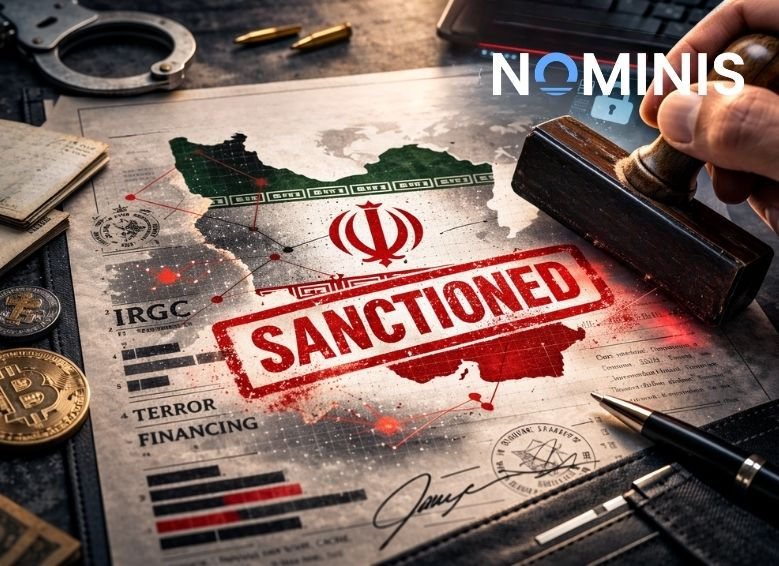
The U.S. Treasury's Office of Foreign Assets Control (OFAC) has sanctioned four major Iranian cryptocurrency exchanges, Nobitex, Wallex, Ramzinex, and Bitpin, alongside multiple associated individuals and entities. The action forms part of the U.S. government's broader efforts to disrupt financial networks linked to sanctions evasion and the Iranian regime: ‘Operation Economic Fury’, a financial warfare effort targeting Iran's economy, military funding, and revenue streams.
According to the Treasury, the designated exchanges collectively represent a significant portion of Iran's digital asset ecosystem, with Nobitex alone accounting for more than half of Iranian cryptocurrency inflows during 2025.
The sanctions come just days after the UK's Office of Financial Sanctions Implementation (OFSI) sanctioned HTX as part of a separate action targeting networks allegedly facilitating Russian sanctions evasion, highlighting a growing trend among regulators to focus on cryptocurrency exchanges themselves as critical financial infrastructure.
Who Was Sanctioned?
The OFAC action targets:
- Nobitex, Iran's largest cryptocurrency exchange.
- Wallex, one of Iran's largest retail trading platforms.
- Ramzinex, a major Tehran-based exchange.
- Bitpin, another significant participant in Iran's domestic crypto market.
- Multiple executives and associated entities linked to the exchanges.
According to the Treasury, the exchanges facilitated transactions connected to sanctioned Iranian interests, including entities linked to the Islamic Revolutionary Guard Corps (IRGC) and other government-controlled financial networks.
The Significance of these Sanctions
While the sanctions against HTX generated considerable industry attention, the Iranian exchange designations may present a more difficult challenge for compliance teams.
Major international exchanges such as HTX are generally well understood by blockchain analytics providers. Wallet infrastructure associated with these platforms has been extensively mapped, making exposure relatively straightforward to identify.
Iran's domestic crypto ecosystem is a different story: many blockchain analytics providers maintain limited visibility into Iranian exchanges, OTC brokers, payment processors, and local crypto businesses. As a result, sanctioned activity may be significantly more difficult to detect despite the existence of sanctions lists.
The challenge is not identifying that a sanctioned exchange exists. The challenge is identifying the wallets and infrastructure connected to it.
A Visibility Problem for the Industry
According to NOMINIS, visibility into Iran's cryptocurrency ecosystem remains one of the industry's largest intelligence gaps.
"While the sanctions of HTX affected almost every platform in the world, it was relatively easy for VASPs to identify wallets linked to HTX," said Snir Levi, CEO of NOMINIS.
"In the case of Iran, the majority of blockchain analytics firms have poor visibility into the local crypto economy. Millions of wallets connected to sanctioned entities may effectively remain invisible to compliance teams, exposing VASPs to significant sanctions evasion risk."
NOMINIS has mapped more than 150 Iranian exchanges and OTC desks, a figure substantially higher than the coverage typically available across the blockchain analytics industry.
According to Levi, "The greatest sanctions risk in crypto is often not the entities everyone knows about, it's the ones that remain unseen. The Iranian crypto ecosystem contains hundreds of exchanges, OTC desks and brokers, yet most compliance tools only map a handful of them. As sanctions enforcement expands, that visibility gap becomes a compliance risk for every VASP connected to the global crypto economy.”
The practical consequences of this visibility gap are already apparent. NOMINIS analysts have observed funds originating from Iranian crypto services reaching licensed exchanges outside Iran, demonstrating that sanctions exposure is not merely theoretical but an ongoing compliance challenge.
A New Phase of Crypto Sanctions
Historically, sanctions enforcement in the cryptocurrency sector focused primarily on individual wallets, ransomware operators, darknet markets, and terrorist financing networks.
Recent actions suggest regulators are increasingly targeting the broader financial infrastructure that enables sanctions evasion. Rather than focusing solely on bad actors, authorities are identifying and sanctioning the exchanges, brokers, and service providers that facilitate access to the global financial system.
For compliance teams, this represents an important shift. The effectiveness of sanctions controls increasingly depends not only on screening designated entities, but on maintaining sufficient visibility into regional crypto ecosystems where sanctioned activity may originate.
The designation of Nobitex, Wallex, Ramzinex, and Bitpin demonstrates that regulators are no longer viewing local exchanges as passive intermediaries. They are increasingly being treated as strategic components of sanctions evasion networks, and compliance programs will need to adapt accordingly.
All research content and accompanying reports are provided for informational purposes only and should not be relied upon as professional advice. Accessing these materials does not create any professional relationship or duty of care. Readers are encouraged to consult appropriately qualified professionals for guidance. We uphold the highest standards of accuracy in all the information we provide. For any questions or feedback, please contact us at contact@nominis.io.