
At the beginning of the month, French bank Credit Mutuel Arkea experienced a significant cyberattack where at least €100 million was stolen.
Two days later, the bank confirmed the cyberattack and suspended some transactions and transfers. According to early reports, the attacking entity, who remain unconfirmed at the time of writing, sent stolen funds from the bank’s own account to crypto accounts, at centralised exchanges, controlled by the entity themselves.
Blockchain investigator ZachXBT shared that the attack hxad lasted several days, and the conversion of the stolen funds into crypto involved stablecoins, meaning the value of the stolen funds remained pegged to the dollar.
The bank reported that once the hack had been identified, the team acted to suspend some transactions to prevent further transfers of stolen funds.
According to reports, the withdrawals involved the usual withdrawal function of an exchange, including widely known centralised Exchanges. Some speculate that a cash-out infrastructure had been operating long before the incident occurred.
What we found On Chain
Multiple theft wallets appear to have been used for this heist. The following is an observation of the on-chain behaviour of two particular wallets that were involved in the exploit and movement of stolen funds.
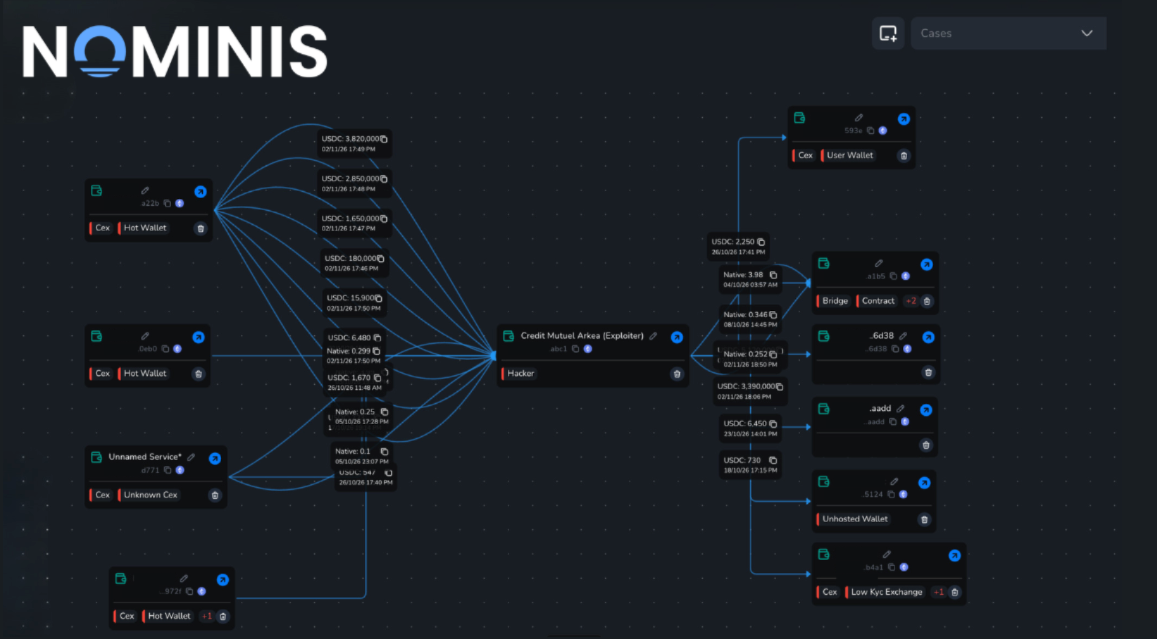
Nominis traced one of the receiving wallets, Wallet..abc1, now labelled as an exploiter address. On 2 November, the wallet received roughly 8.5 million USDC from a single well known CEX hot wallet in five withdrawals made within four minutes. The sequence opened with a 180,000 USDC transfer, followed by progressively larger amounts of 1.65 million, 2.85 million and 3.82 million USDC, with a small top-up of 15,900 USDC at the end. A second hot wallet of the same CEX sent a smaller amount at around the same time. Nominis assesses that the opening transfer served as a test before the account was drained.
The funds did not stay long. Within about an hour, the wallet moved out almost exactly the amount it had received, in two large USDC transfers of approximately 5.12 million and 3.39 million to unlabelled wallets, followed by a small amount of ETH to cover gas fees on the onward leg.
Most notably, the wallet was not created for the attack. It was active from early October, a month before the incident, when it received small ETH deposits from FixedFloat, a low-KYC instant exchange, and from an unidentified centralised exchange. Over the following weeks it made a series of low-value transfers to the cross-chain swap service Bridgers, the crypto card provider RedotPay, a Trust Wallet address and another unlabelled wallet. Nominis assesses that this history is consistent with reports of pre-positioned cash-out infrastructure, and that the wallet’s prior interactions with identity-linked services such as RedotPay offer potential avenues for attribution.
Second exploiter, Same Pattern
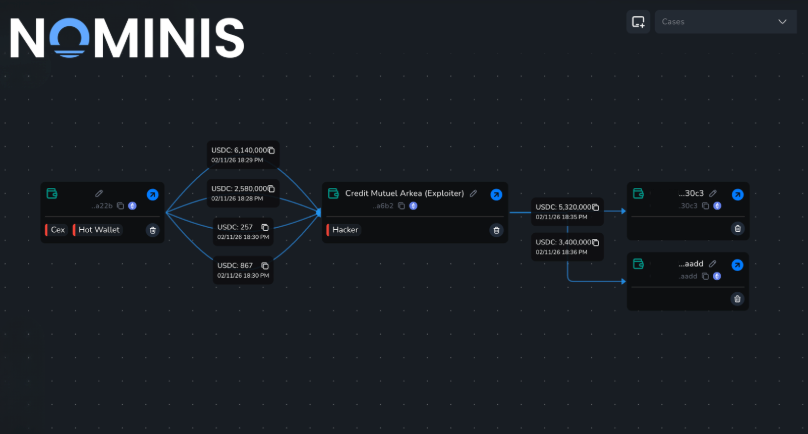
A second exploiter address, Wallet ..a6b2, shows the same playbook at greater speed. Around 40 minutes after the first wallet was drained, it received roughly 8.72 million USDC from the same CEX hot wallet in four withdrawals over about two minutes: 2.58 million USDC, then 6.14 million USDC, followed by two small transfers of 257 and 867 USDC. Unlike the first wallet, there was no smaller opening transfer. The two trailing amounts are consistent with an account being swept off its remaining balance.
Within six minutes of the last deposit, the wallet had sent the funds onward in two transfers: 5.32 million USDC to Wallet ..30c3 and 3.4 million USDC to Wallet …aadd. Together these account for all but around 1,100 USDC of what the wallet received, meaning the stolen funds spent only minutes at this address.
The more significant finding is where the second transfer went. Wallet ...aadd also appears in the history of the first exploiter wallet, which sent it 6,450 USDC on 23 October, more than a week before the attack. Nominis assesses that Wallet...aadd is a consolidation point linking at least two of the receiving wallets, and that its involvement before the incident supports reports that the cash-out network was assembled in advance. That link also makes it a priority address for tracing where the funds went next.
A Nervous Month for Finance
Arkea came days after Binance lost $6.3 billion on 29 October, the largest theft in crypto history. When Bank of America, JP Morgan Chase and Zelle went offline across the US on 16 November, most immediately assumed it was another attack: however, JP Morgan shared publicly that their issue was a software bug and had no evidence it was cyber related.
Lesson from the Attack:
The first lesson is that a bank does not need to hold any digital assets to suffer a crypto incident. Crédit Mutuel Arkéa’s losses began as ordinary fiat transfers, and crypto served purely as the exit route. Fraud teams at traditional institutions now need visibility into where outgoing transfers end up, including whether the receiving account belongs to an exchange that allows rapid conversion and withdrawal.
Second, identity checks at onboarding are only part of the picture. The exchange accounts used here had passed KYC, but under fabricated identities. What should have stood out was behaviour: large inbound transfers from a single corporate bank account, converted and withdrawn within minutes to wallets whose history included low-KYC swap services. Screening the destination wallet at the point of withdrawal, and not only the customer at the point of sign-up, is where exchanges have the best chance of stopping funds before they leave.
Third, the infrastructure was built in advance. Wallets that had received exchange payouts for months were mistaken for legitimate addresses at first. A wallet’s age and history are not evidence of legitimacy, and a dormant or low-activity wallet that suddenly receives millions should be treated as a red flag, not a reassurance.
Some of the involved theft addresses include:
0xADd95cD98E0288ba69785E3151E1db86adF8Dd58
0x29e9D7715D935e0D0D4B0DD0efC952A97E551020
0x378B4f150707C283574DC89739608D29036D57d5
0x795a9d22F233024487161Fe6daFf73397c162621
0x730Bcb1296758c377149d7409f98f041cf723992
0x12D9012731eb0D54871A31Af5566Eb9ECCa351Db
0x5A154f77852ed274Fd6F4c324a1Ee27809052FF7
0xA1096A66f9ed58A9594A6A1ad67A5472C0907224
0x90F0b6D51ed2FE2348A45b2C49BC441E959bc557
0x8A97BC406180e28b11C5495fA099BF5119c6C6B0
0xd010cba790a6ab0048da18f2fbe8e3faf463a16a
0x5cf70edce65847ef989933c3072fb0e7f335abc1
0xe378cdccb369a64a0190577787ef61ca2eefa6b2
0x3e6c3d135ca8f8be793e5fe1715ce6c057d140f2
0x99d314e6970b8d3db0dbe6f6e041cc904143400f
This is an evolving story and as Nominis, as well as other professionals in the industry, track the movement of the stolen funds, the list will be edited accordingly.
All research content and accompanying reports are provided for informational purposes only and should not be relied upon as professional advice. Accessing these materials does not create any professional relationship or duty of care. Readers are encouraged to consult appropriately qualified professionals for guidance. We uphold the highest standards of accuracy in all the information we provide. For any questions or feedback, please contact us at contact@nominis.io.
