This is a developing story. The NOMINIS research team endevours to ensure facts are checked before publication.
The relationship between the United Arab Emirates and Iran has long been defined by contradiction.
Publicly, the UAE positions itself as a modern, Western aligned economic hub committed to regional stability. But privately and commercially, it has remained one of the most significant financial and logistical gateways for Iranian capital, including networks linked to the Islamic Revolutionary Guard Corps (IRGC).
UAE and Iran’s deep commercial relationship, allow sanctions evasion
For years, the UAE has functioned as a financial pressure valve for Iran, maintaining robust commercial ties. Iran’s non-oil exports to the UAE have reportedly reached over $1 billion dollars worth to Iran, making it a top three importer of non-oil goods.
Meanwhile, in December 2025, Iran’s Transport and Urban Development minister characterized the UAE openly as one of Iran’s principle trading partners. After China, the UAE has the largest amount of trade relationships with Iran, with total bilateral trade reportedly reaching over $27 billion dollars. To allow Iranian traders to access UAE business networks, plans were in place to establish a UAE Chamber representative in Iran, with counterparts based in the Emirates, to allow even greater trade expansion.
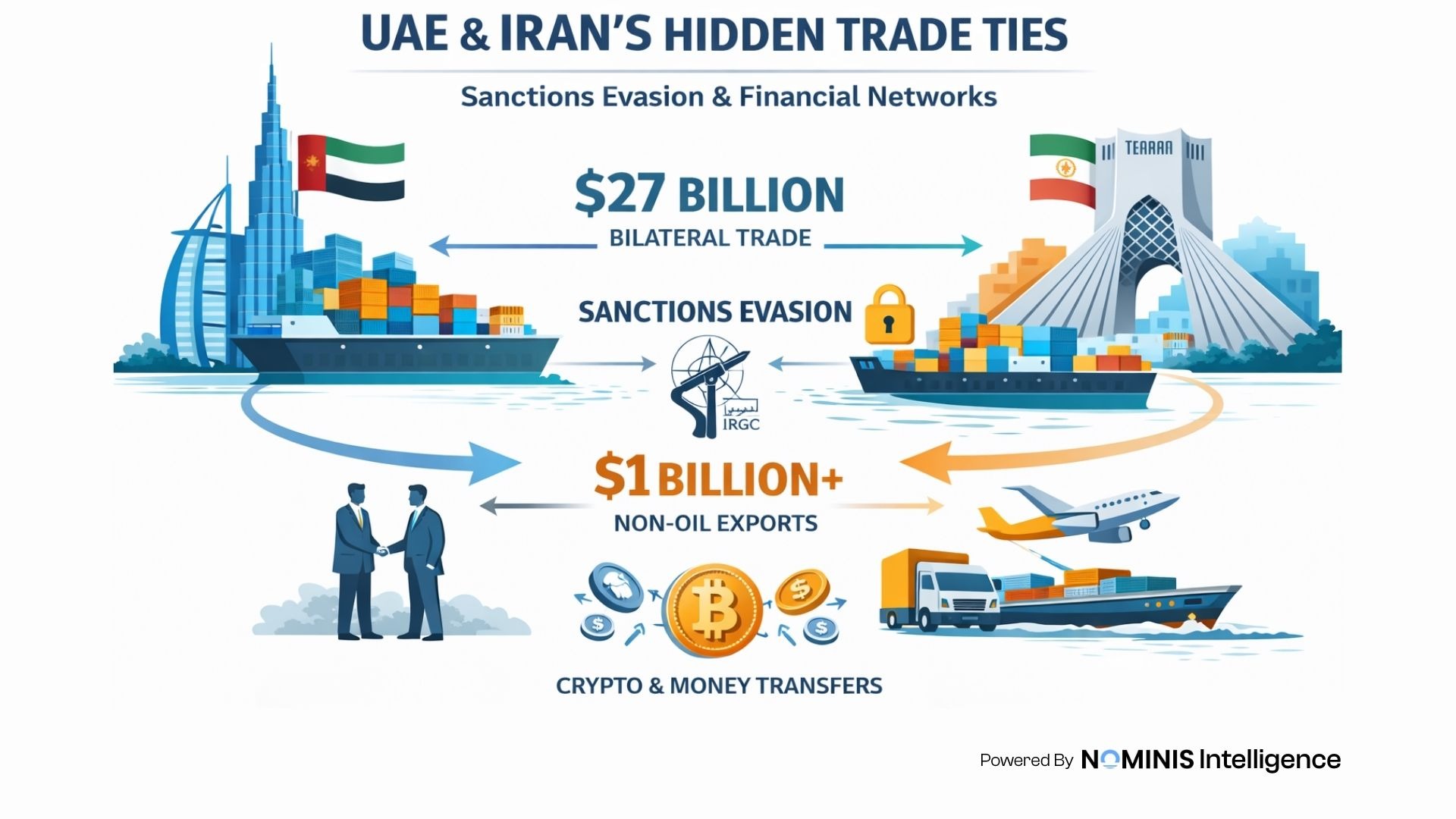
These figures reflect an economic interdependence that goes far beyond occasional import-export activity; they signal a deep integration of bilateral trade networks across logistics, business communities, and financial flows.
Critically, these deep financial relationships are not been limited to traditional finance. As digital assets have matured, crypto infrastructure has increasingly played a parallel role, creating additional channels for value transfer beyond formal banking rails.
NOMINIS insights recognise that UAE-based exchanges have been accepting transactions from both Hamas-run and IRGC-run wallets.
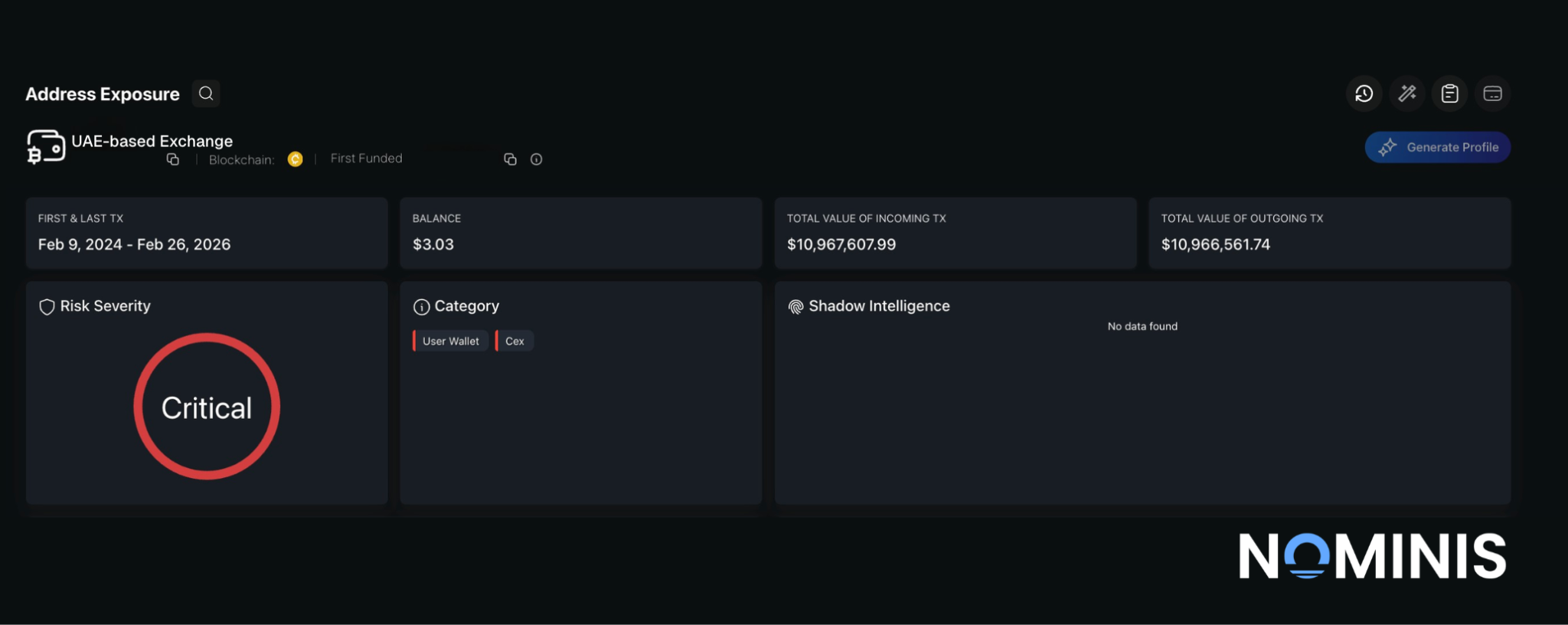
Through structured on-chain analysis, NOMINIS identified approximately $11 million in inflows into a UAE-based exchange wallet referred to as Wallet TFod.
The wallet remains active and has consistently received transfers from addresses attributed to IRGC-linked entities, Hamas-associated wallets, and Lebanon-based brokerage intermediaries, indicating sustained exposure to networks operating within sanctioned and high-risk environments.
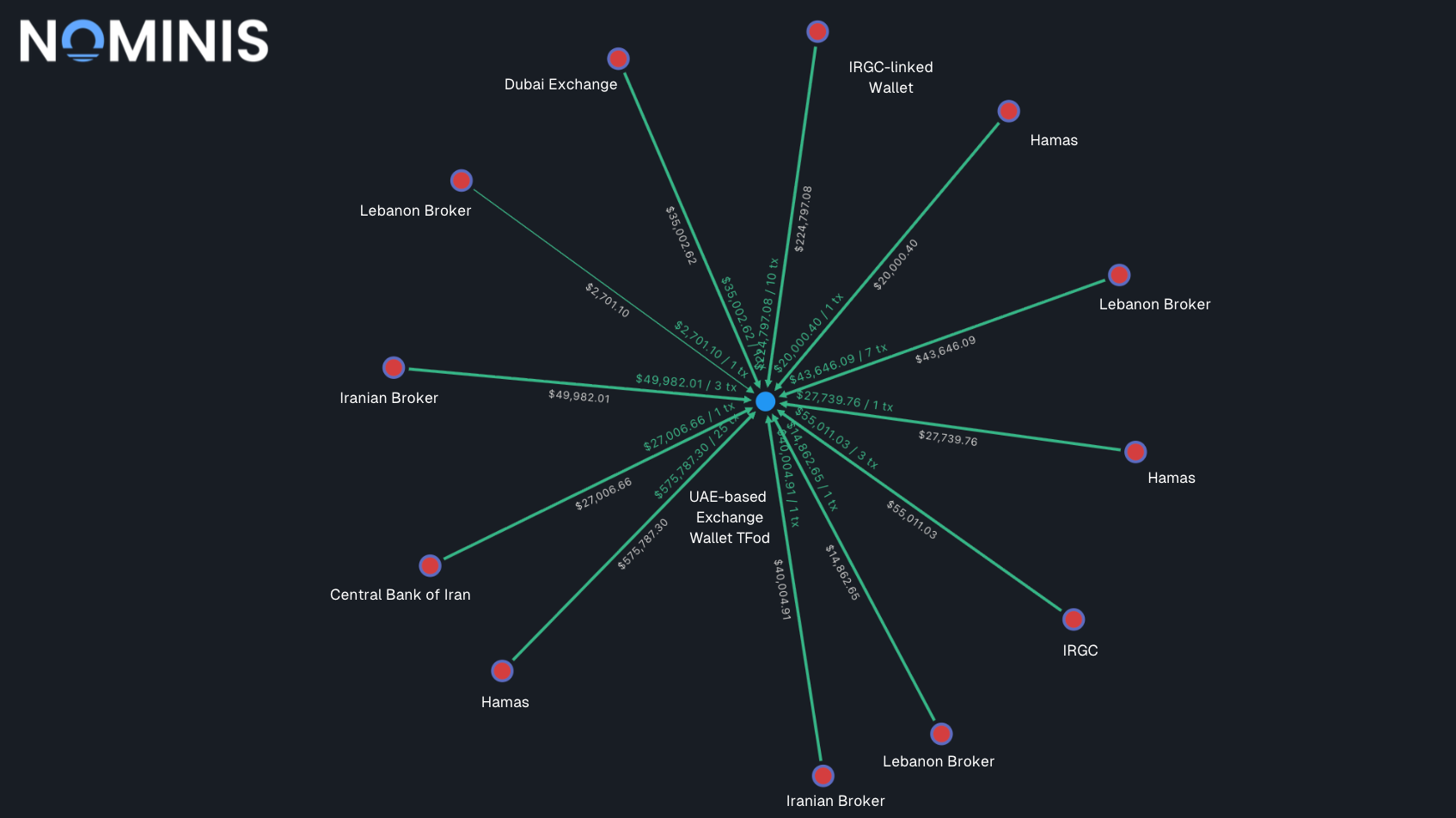
Similarly, Wallet TPv2, also attributed to a UAE-based exchange, reflects a comparable pattern of exposure.
On-chain analysis shows that the wallet has repeatedly received transfers from addresses linked to IRGC-controlled entities and has processed over $53 million in total transaction volume, underscoring the scale and persistence of the financial flows involved.
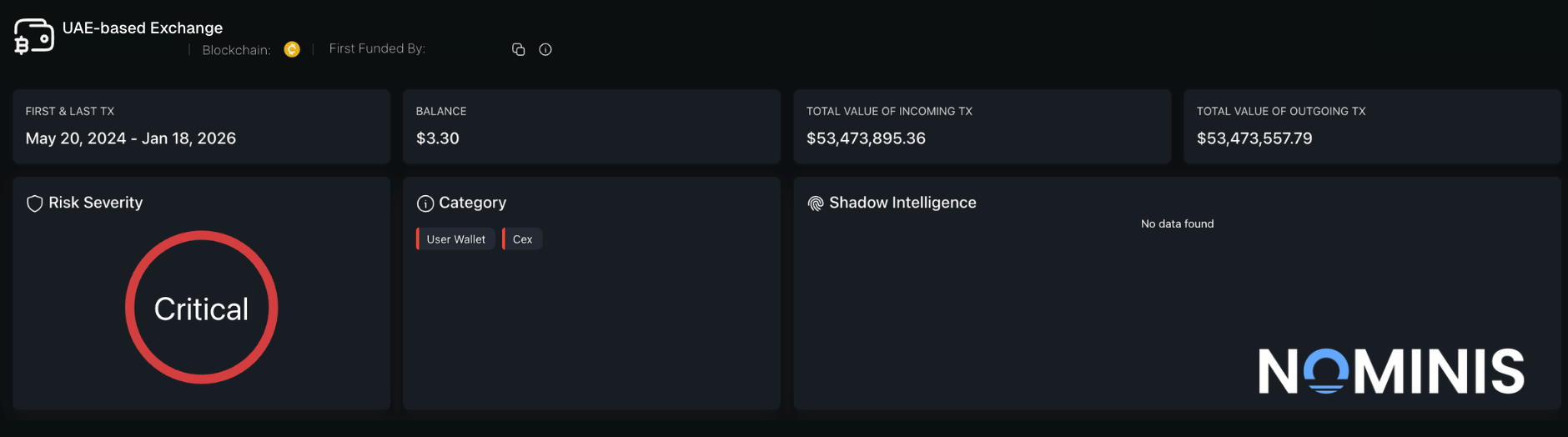
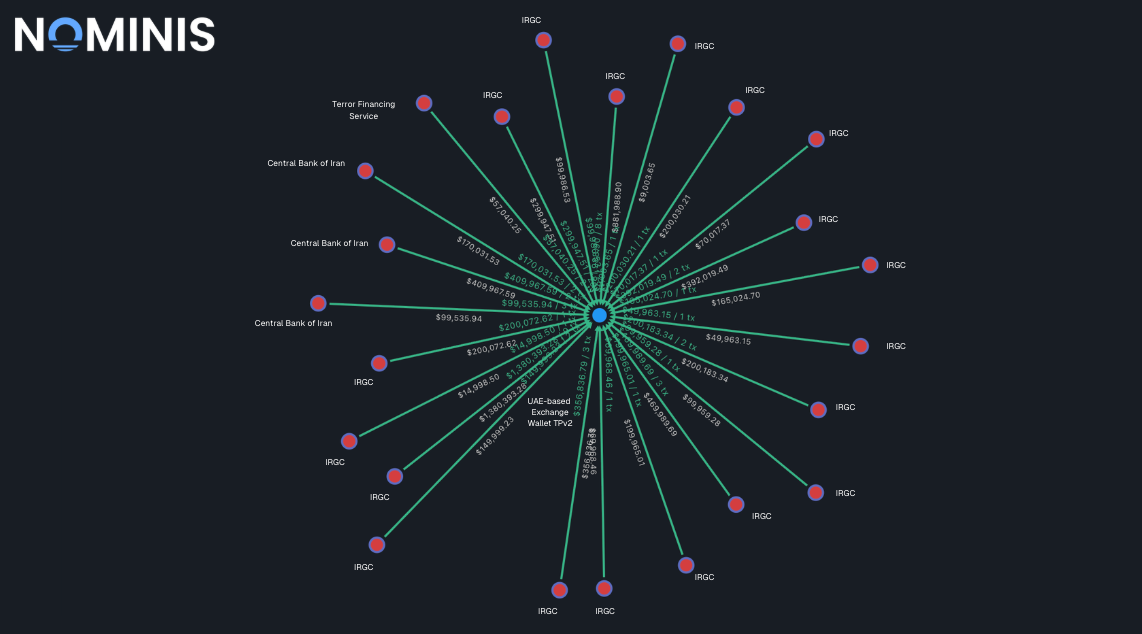
Meanwhile, the NOMINIS database contains over 300 UAE-based wallets, that have direct connections with the IRGC, whether they have received funds from the terror state, or use the same wallet infrastructure.
Cracks in the Strategic Equilibrium
On 28 February 2026, this uneasy equilibrium UAE has been balancing with Iran has fractured.
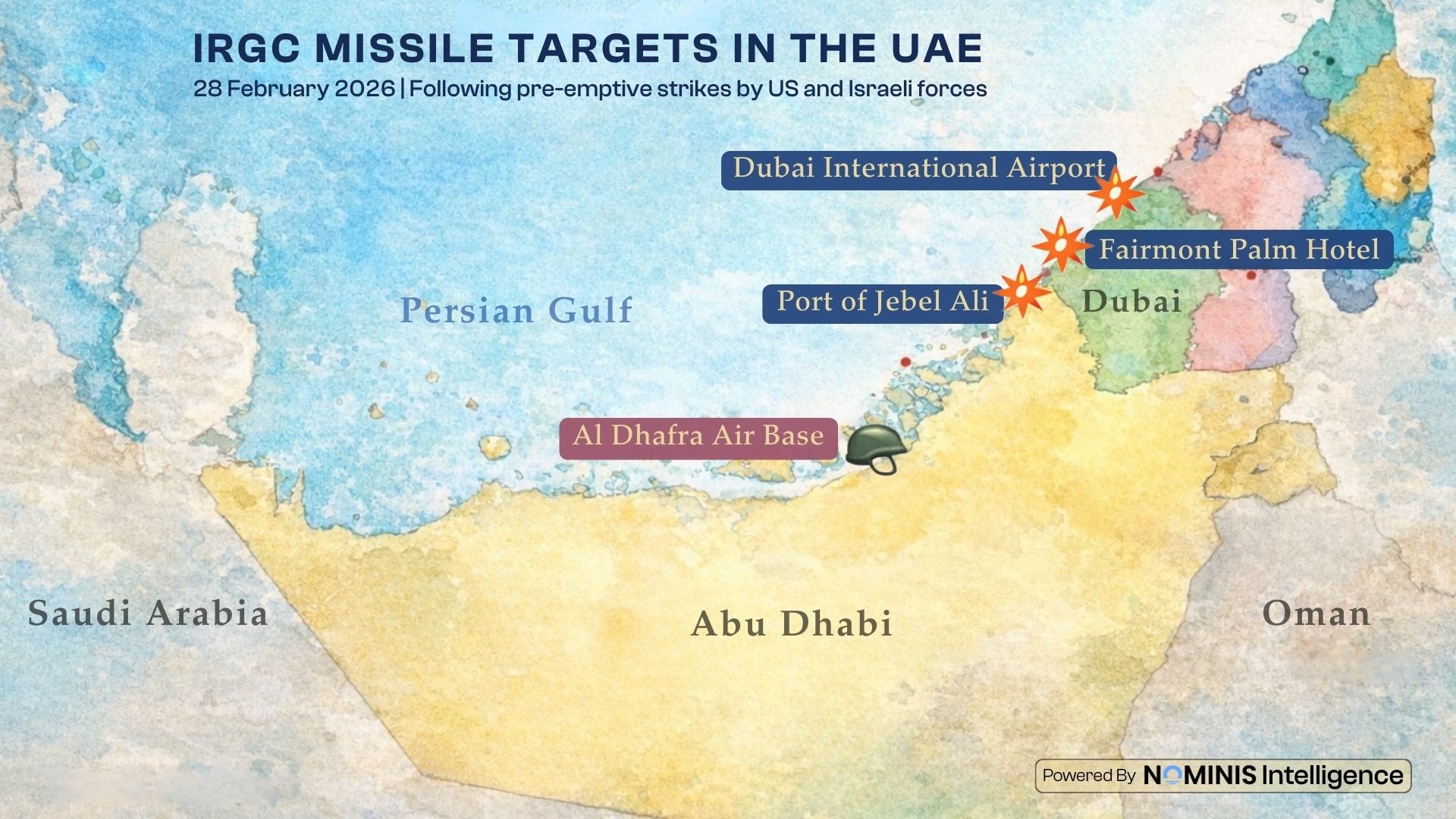
Following pre-emptive strikes by US and Israeli forces, Missile strikes attributed to the IRGC struck civilian infrastructure in Dubai, including the Fairmont The Palm Hotel on Dubai’s Palm Jumeirah, Jebel Ali Port, and Dubai International Airport. At the same time, Al Dhafra Air base in Abu Dhabi, operated jointly between the US Air Force and the UAE Air Force, was also attacked.
This dual targeting is strategically significant: Dubai does not host a formal US Airbase. While Jebel Ali Port is the US Navy’s largest port of call in the Middle East, often accommodating US aircraft carriers and vessels, it is not an official military installation, but an important trade port.
Al Dhafra, by contrast, represents a clear and acknowledged US military presence.
The fact that both military infrastructure in Abu Dhabi, and civilian-economic infrastructure in Dubai, suggests an IRGC goal beyond targeting US forces in the region, but actually signalling a direct warning to the UAE’s economic heart, which typically, Iran is deeply tied with.
Other Gulf states hosting US military bases, including Qatar, Bahrain, Jordan and Kuwait, have reported intercepting missiles fired towards their territories. The broader campaign appears coordinated.
Other Gulf states hosting US military bases, including Qatar, Bahrain, Jordan and Kuwait, have reported intercepting missiles fired towards their territories. The broader campaign appears coordinated. Other Gulf states hosting US military bases, including Qatar, Bahrain, Jordan and Kuwait, have reported intercepting missiles fired towards their territories. The broader campaign appears coordinated. But the inclusion of Dubai’s civilian and commercial zones in the attack pattern suggest that the escalation was not limited to military deterrence; it reached into the UAE’s financial and economic core.
A Diplomatic Contradiction
The dual targeting of Al Dhafra Air Base and Dubai’s civilian infrastructure makes UAE’s foreign policy positioning strategically significant.
In recent years, the UAE has actively strengthened ties with Israel through the Abraham Accords. It has welcomed Israeli tourism and investment, expanded intelligence and security cooperation, and taken firm domestic positions against antisemitic violence and extremism.
Alongside its defence partnership with the US, this has positioned the UAE as an increasingly integrated player within Western-aligned entities.
Yet, this realignment has unfolded, of course, against the backdrop of deep economic ties with Iran. The UAE functions not only as a commercial hub for Iranian goods, but as critical economic gateway, facilitating trade both in the traditional form and in cryptocurrency. This has generally softened the impact of international sanctions placed on Iran.
The strikes on both military and civilian targets now bring this dual posture into sharp focus.
Economic Interdependence has not earnt Dubai immunity
This layered relationship places the UAE in a narrowing strategic space:
Can a state sustain deep commercial and financial corridors with a sanctioned adversary while simultaneously embedding itself more firmly within Western and regional security alliances?
The missile attacks elevate that question from theoretical to immediate. Economic accommodation, whether through conventional trade channels or emerging financial mechanisms such as crypto and digital assets, does not necessarily provide insulation during escalation. In moments of confrontation, interconnectedness can become exposure.
The UAE therefore faces a defining choice.
It may choose to deepen alignment with Western and Gulf security partners, reinforcing enforcement against Iranian-linked commercial and financial networks operating within its jurisdiction, including digital value transfer channels. However, this would mean a potential cessation of bilateral trade partnerships with Iran. This is a seemingly more enticing option, given the weakening of the IRGC as a government of Iran following the elimination of Ali Khameini, leader of the IRGC, on 28 February.
Alternatively, the UAE may choose to continue pursuing commercial pragmatism alongside strategic balancing, even as its economic and military infrastructure becomes directly entangled in regional confrontation.
The direction Abu Dhabi chooses will shape not only its own security and economic trajectory, but potentially the broader stability architecture of the Gulf, particularly as trade, sanctions policy, military posture, and digital finance become increasingly interconnected in a contested regional order.
NOMINIS Concluding Insights:
The UAE-Iran dynamic illustrates a broader reality of modern finance: economic interdependence, sanctions exposure, and digital asset infrastructure are now inseparable from geopolitical risk.
When jurisdictions serve as trade hubs and crypto gateways for sanctioned actors, financial flows can evolve into strategic vulnerabilities. What begins as commercial pragmatism can become regulatory exposure, and, in moments of escalation, a national security liability.
For institutions operating in high-risk corridors, proactive monitoring of cross-border trade networks, beneficial ownership structures, and on-chain activity is no longer a compliance exercise, it is a strategic imperative.
All research content and accompanying reports are provided for informational purposes only and should not be relied upon as professional advice. Accessing these materials does not create any professional relationship or duty of care. Readers are encouraged to consult appropriately qualified professionals for guidance. We uphold the highest standards of accuracy in all the information we provide. For any questions or feedback, please contact us at contact@nominis.io.