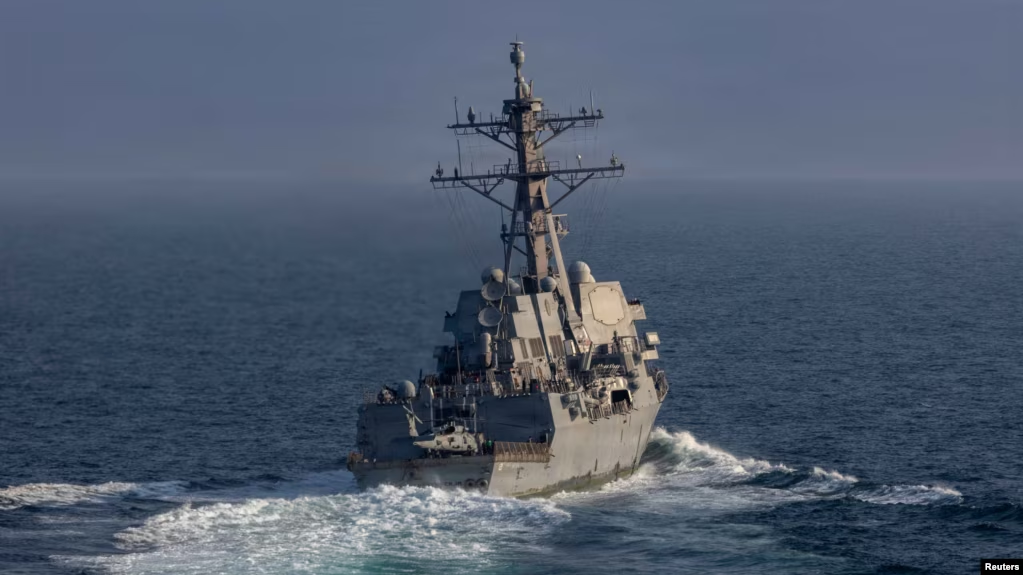
As Washington moves to choke off Iran’s trade through a naval blockade, a critical question remains: can economic pressure succeed if actors like the Islamic Revolutionary Guard Corps still have access to a growing cryptocurrency lifeline?
The United States’ strategy rests on a familiar premise: restricting exports and imports, Washington seeks to squeeze Iran’s economy and weaken the financial foundations of its government body, the IRGC. The focus has been firmly on shipping routes, ports and the physical movement of goods as the main levers of pressure. That emphasis has only intensified amid tensions in the Strait of Hormuz, a vital chokepoint under Iranian control where mines have reportedly been deployed to disrupt allied shipping.
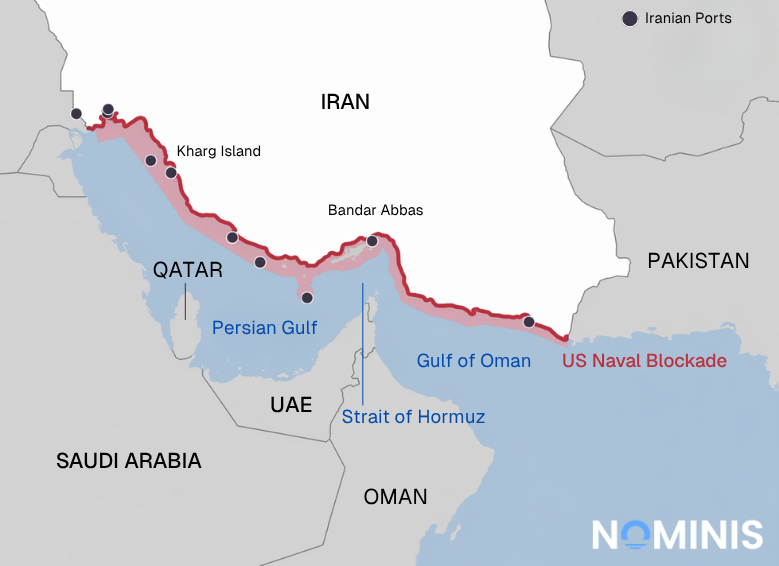
Around a fifth of the world’s oil and liquefied natural gas typically passes through the strait, and the conflict has already sent global fuel prices sharply higher.
However, efforts to strangle the IRGC’s economy have never been confined to the sea.
In recent years, Iran has increasingly turned to alternative financial systems, to evade Western sanctions placed. We have recognised and reported a rise in cryptocurrency activity linked to the country, alongside IRGC’s broader efforts to reduce reliance on Western controlled financial infrastructure. These developments point to a structural shift: while traditional channels can be restricted, parallel systems continue to evolve.
Danny Citrinowicz, Senior Researcher in the Iran and the Shi'ite Axis Program at the Institute for National Security Studies captured this dynamic:
Without meaningful sanctions relief, ‘Iran’s economic trajectory will increasingly anchor itself in alternative systems, chiefly, dependence on the Chinese yuan and non-Western trade mechanisms as a means of survival.’
On the potential success of the blockade, Citrinowicz reflected ‘If the strategic objective is to constrain Iran’s economy, and more importantly, its ability to conduct international business then the focus should shift accordingly.Maritime pressure can create friction, but it does not fundamentally reshape Iran’s economic orientation.’
‘The real leverage lies in whether Iran remains partially integrated into the global financial system or is pushed further into parallel economic structures led by China. Once that shift deepens, Western influence diminishes significantly, and the cost of reversing it rises.’
‘In that sense, the key question is not only how to pressure Iran, but where that pressure is directed, and what long-term economic architecture it ultimately produces.’
Citrinowicz’s argument points to a deeper limitation in the current approach taken to choke Iran’s economy. A blockade may disrupt trade, but if Iran is able to redirect financial flows, whether through China-based trade, informal networks or cryptocurrency, then the pressure applied by the blockade risks being offset elsewhere.
The role of crypto in IRGC funding
This is where the role of crypto becomes particularly significant. Unlike oil shipments or physical goods, digital transactions cannot be intercepted by naval forces. If entities linked to the IRGC are able to move value, receive payments or settle transactions through decentralised networks, then a key assumption underpinning the blockade begins to break down. Economic isolation depends not only on restricting goods, but on constraining the systems that enable exchange.
A partial blockade, in this sense, may do more than fall short: it may accelerate adaptation. As traditional routes become harder to access, the incentive to deepen ties with alternative financial systems only grows. The shift that Citrinowicz describes, towards parallel economic structures and non-Western mechanisms, is not a distant possibility but an ongoing process. Without pressure in those spaces, it is likely to intensify.
The lesson is a familiar one: Sanctions are only effective when they are comprehensive. When gaps remain, they are quickly filled, and today, those gaps are increasingly digital.
Founder and CEO of NOMINIS, Snir Levi, has been following the evolving sanctions landscape around Iran closely.
‘A naval blockade will only be effective if it is sustained over a period of months,’ he explains. ‘In the short term, however, the immediate tactical priority should be to cut off the IRGC’s crypto lifeline, an area the West has consistently failed to address as part of broader sanctions enforcement.’
If the aim is to constrain actors such as the Islamic Revolutionary Guard Corps, then pressure must reach the financial channels they depend on, not just a maritime blockade.
Levi notes that this shift could have direct implications for blockchain activity and industry participants. ‘We may start to see increased movement across wallets linked to the IRGC, often accompanied by rapid obfuscation tactics. That raises the risk profile across the ecosystem,’ he says.
‘For VASPs in particular, they must be significantly more alert: the likelihood of coming into contact with suspicious or sanctioned funds has increased, and firms should be prepared to respond accordingly’.
Looking for a new KYT transaction monitoring tool, to ensure your exchange is compliant?
Book an intro call with our sales team with this Calendly link or email contact@nominis.io.
All research content and accompanying reports are provided for informational purposes only and should not be relied upon as professional advice. Accessing these materials does not create any professional relationship or duty of care. Readers are encouraged to consult appropriately qualified professionals for guidance. We uphold the highest standards of accuracy in all the information we provide. For any questions or feedback, please contact us at contact@nominis.io.