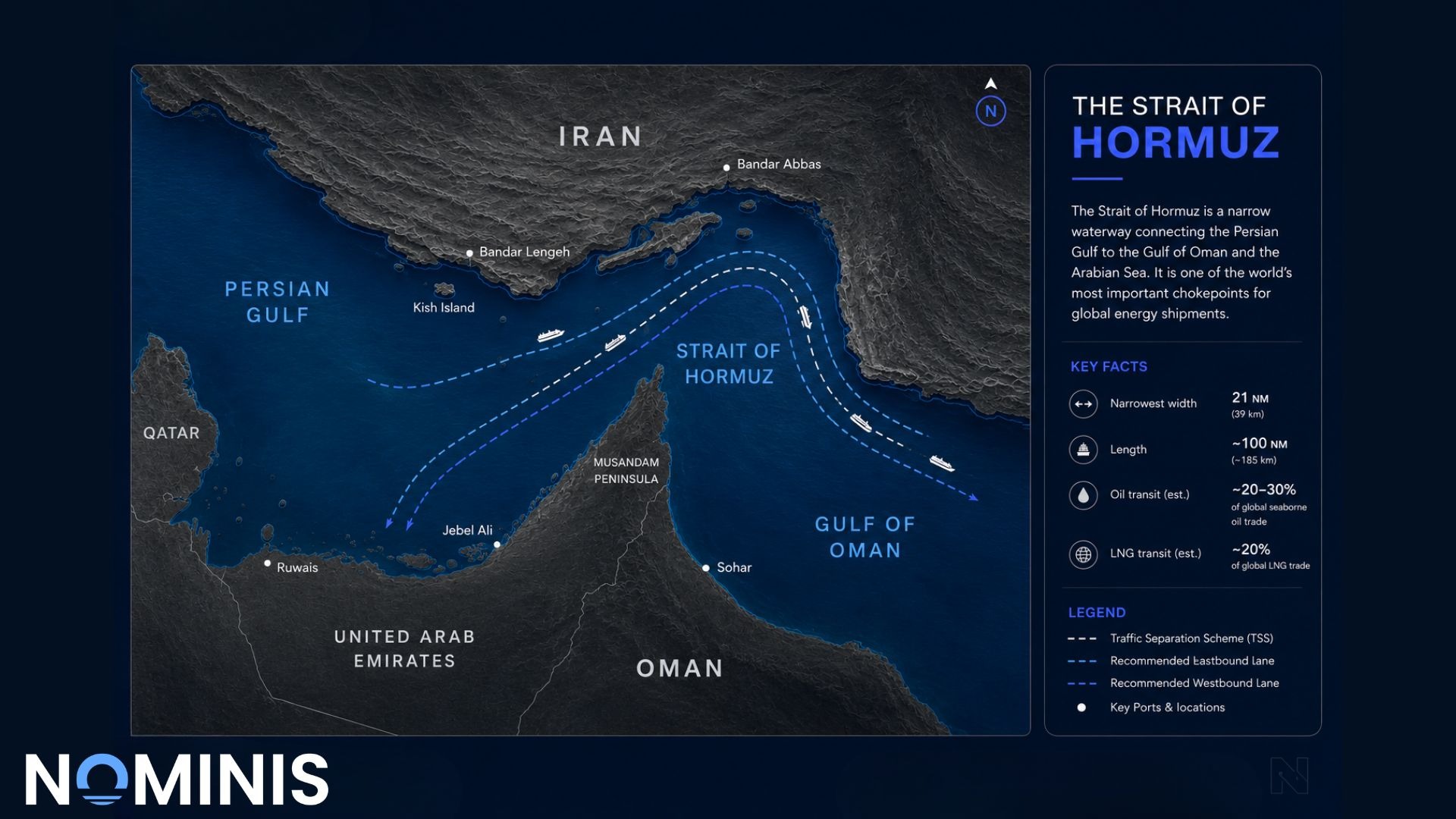
In mid-March 2026, the Financial Times reported that Iran had introduced a new levy on vessels transiting the Strait of Hormuz: $1 per barrel of oil carried, payable in either Bitcoin or TRON. The detail that mattered most was not the cost, but the currency. The IRGC was not asking for dollars, or rials, or any instrument that would leave a trace in the traditional financial system. It asked for cryptocurrency, settled on-chain, outside the reach of the correspondent banking infrastructure that sanctions enforcement has historically depended on.
By early May 2026, that arrangement had been given a new name and a new wrapper. A website appeared at hormuzsafe[.]ir, accessible for now only from within Iran, presenting what it calls a maritime insurance program for Hormuz transit. The product is called Hormuz Safe, and its premiums are payable in Bitcoin. The toll is marketed as an insurance product, and the IRGC had graduated from charging a fee to offering coverage.

The Role of Cryptocurrency
The selection of Bitcoin, and previous use of TRON for the original March toll, reflects the IRGC’s reliance on cryptocurrency in their financial system.
TRON-based transactions have appeared consistently in the IRGC linked sanctions evasions cases over the past several years - the low fees, fast settlement and dollar-pegged liquidity of USDT that does not touch the dollar system.
Bitcoin brings a different kind of utility, more widely recognised internationally and more plausibly framed as a legitimate commercial payment in jurisdictions where enforcement of US sanctions is inconsistent.
Taken together, the two networks represent a deliberate and now structurally embedded component of how the IRGC collects and moves funds. Hormuz Safe is not a departure from that pattern; it is an extension of it, with an institutional veneer added on top.
The reframing adds something the informal toll never had: a recorded transaction that can be presented as commercial insurance revenue, settled through a payment rail that avoids sanctions-exposed infrastructure entirely.
Babak Zanjani
The individual who began publicly promoting Hormuz Safe at its launch is Babak Zanjani, and his involvement is instructive on more than one level. Zanjani is listed on the OFAC SDN list designated as a key facilitator of Iranian oil sales in violation of international sanctions and responsible for moving hundreds of millions of dollars on behalf of the Iranian government.
Zanjani also held a directorship in Zedcex and Zedxion, UK-registered cryptocurrency exchanges that were sanctioned earlier this year after NOMINIS contributed to an investigation, published by The Washington Post, tracing over $150 million in transactions Zedcex processed on behalf of the IRGC. And it has not prevented him from serving as the public face of Hormuz Safe.
His continued operational relevance points to something the compliance community has been grappling with as crypto becomes more central to sanctions evasion: designation works as intended within the traditional financial system, but it creates far less friction in jurisdictions with weaker enforcement, or on financial rails that don't pass through that system at all. Zanjani is not operating in spite of his SDN status so much as he is operating around it, which is an entirely different problem, and subsequently requires a different approach.
Consequences for Crypto Compliance
The transactional risk from Hormuz Safe is very straightforward - funds connected to the program carry full sanctions exposure, and Zanjani’s involvement reflects a continuation of IRGC dependency on his network, despite his designation.
If designated individuals can continue operating by routing activity through cryptocurrency networks, even when their digital asset addresses are included in the designation, then monitoring those networks as a purely transactional level, and watching for known on-chain patterns, is necessary but not sufficient enough.
The cases of Zedcex and Hormuz Safe are built on real-world networks, corporate structures and individual actors whos connection to sanctioned entities exists largement off-chain. Identifying those connections requires combining on-chain analytics with intelligence that sits outside the blockchain entirely: registry data, geointelligence signals, OSINT, and accumulated knowledge of individuals who are operating on behalf of sanctioned governments and proscribed organizations. Knowing who controls a wallet often depends on information that no blockchain explorer could surface.
This is the core of NOMINIS’ approach to IRGC-linked network mapping. Rather than treating the blockchain and transactions as the primary record and everything else as supplementary, we work in the other direction: exploring real world situations, building profiles of the individuals and entities involved, understanding their relationships and corporate footprints, and using that context to interpret what the on-chain activity actually represents.
In the case of the Zanjani network, that means tracking not just wallet addresses associated with his known associates, but the broader web of entities, jurisdictions, and financial relationships that those addresses connect to in the real world.
Hormuz Safe effectively displays why this approach is critical. The program did not appear from nowhere; it was promoted by a known individual with a documented history, built on an infrastructure that now can be mapped, and launched on a timeline following a pattern of escalating use of cryptocurrency by IRGC which we have been tracking for some time. The on-chain activity will matter when funds start moving. But the intelligence that makes those transactions interpretable already existed before the first vessel pays the new Hormuz Safe Insurance premium.
All research content and accompanying reports are provided for informational purposes only and should not be relied upon as professional advice. Accessing these materials does not create any professional relationship or duty of care. Readers are encouraged to consult appropriately qualified professionals for guidance. We uphold the highest standards of accuracy in all the information we provide. For any questions or feedback, please contact us at contact@nominis.io.