Not All Crypto Transaction Monitoring is Built for the Same Purpose
Crypto transaction monitoring has become a regulatory requirement for Virtual Asset Service Providers (VASPs) worldwide. As regulators introduced AML, CTF, sanctions, and Travel Rule obligations, exchanges and fintechs were forced to turn to well-known analytics providers such, as Chainalysis and TRM Labs, to maintain compliance.
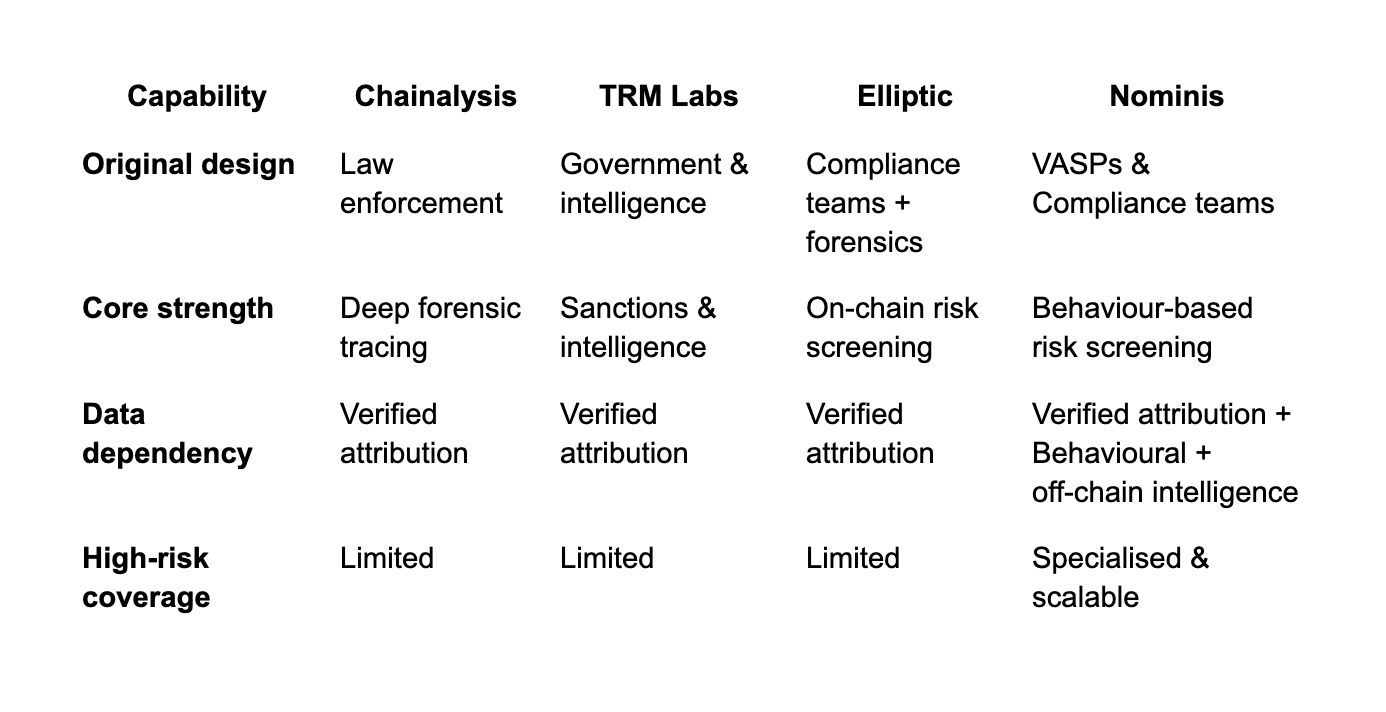
However, these platforms were not originally built for VASPs, who need simple, accessible risk screening. They were built for law enforcement and forensic investigations.
This distinction is important: choosing an unsuitable transaction monitoring tool can lead to unnecessary complexity, higher costs, slower investigations, and compliance teams drowning in features they never needed.
It’s important, therefore, that we assess how Chainalysis, and TRM Labs were originally designed, why Elliptic, though designed for VASPs, still lacks analytical rigour, and how NOMINIS can ease the route to quality compliance for VASPs.
The Origins of Blockchain Analytics: Built for Law Enforcement
Chainalysis
Chainalysis was born out of necessity during early major crypto incidents, such as the Mt Gox hack. The need to investigate crypto hacks led to the creation of companies focused on blockchain tracing, specifically for law enforcement and government investigations, such as the FBI, DEA and IRS, to analyse the public ledger for illicit activity.
From the beginning, its primary users were law enforcement agencies, government investigators ,and intelligence and regulatory bodies, and their platform is built, naturally, to suit the needs of these entities. The platform excels at deep-fund flow tracing, evidence-grade transaction reconstruction, and visualisation of complex investigative workflows.
These capabilities are certainly essential for building up criminal cases, but they are often beyond what a VASP needs for day-to-day crypto compliance.
TRM Labs
TRM Labs was founded to address the growing intersection for crypto, sanctions, fraud and national security, specifically supporting government and public sector agencies, regulators, and financial institutions handling cross-border transactions.
TRM Labs are particularly strong in attribution of wallets and entities, and forensic analytics. And while these capabilities are incredibly powerful, they reflect investigative intelligence tooling, rather than lightweight compliance screening, suitable for VASPs.
The Problem with Using Forensic Tools for Compliance
Using law enforcement grade forensic tools for routine compliance can often lead to:
- Over-complexity: compliance teams spend excessive time navigating tools designed for investigators, not risk officers
- Operational Friction: alert fatigue, unclear risk signals, and longer investigation times that slow down transaction approvals
- Misaligned Risks Assessment: using forensic tracing focuses on where the funds go, rather than whether risk exists.
VASPs Need Purpose Built Risk Screening with Off-Chain Intelligence
Elliptic
Elliptic was an early pioneer in crypto AML compliance. They provide risk scoring, wallet attribution and transaction monitoring, however, their investigative processes rely heavily on on-chain attribution, and verified sources. While this approach works well in jurisdictions and ecosystems where attribution is mature and publicly documented, this becomes significantly less effective when the information is much more difficult to obtain.
In these environments, much of the most critical intelligence does not exist cleanly on-chain. It sits ‘under the hood’, embedded in transaction behaviour, service interaction patterns, and operational fingerprints that cannot be captured through verified attribution alone.
Why High Risk Exposure is Often Missed
Over the past week alone, Nominis identified more than 100 wallets linked to services operating in high-risk jurisdictions. These services facilitated over $300 million in transaction volume during the same period.
Other vendors did not flag any of these wallets.
This gap highlights the structural limitations in forensic-first platforms. Forensic tools depend heavily on verified entities and confirmed labels, which are rarely available in high-risk jurisdictions. As a result, risk often goes undetected, not because it does not exist, but because the right tools were not used to recognise it.
The NOMINIS Approach: Comprehensive, Multi-Source Compliance
NOMINIS was specifically built to cover the full spectrum of crypto risk screening, and compliance tasks, required by VASPs. Its approach combines on-chain data, off-chain intelligence, and behavioural analytics to deliver risk screening that are both broad and specific, making compliance simpler, and more actionable.
Multi-Source, Multi-Skill Capabilities
NOMINIS integrates a variety of skills and functions, including:
Risk Screening Across the Crypto Ecosystem:
Evaluates wallets and transactions against comprehensive risk indicators, including exposure to high risk entities, terror financing, and sanctions.
Wallet Attribution and Clustering:
Maps wallets at scale using advanced analytics, identifying clusters and networks even when verified sources are limited or unavailable
Transaction Monitoring:
Continuously tracks fund flows across over 70 blockchains, alerting teams to suspicious or high-risk behaviour.
Behavioural and Pattern Analysis:
Detects unusual transaction patterns, proxy use or indirect exposure that may indicate laundering, or terror-linked activity.
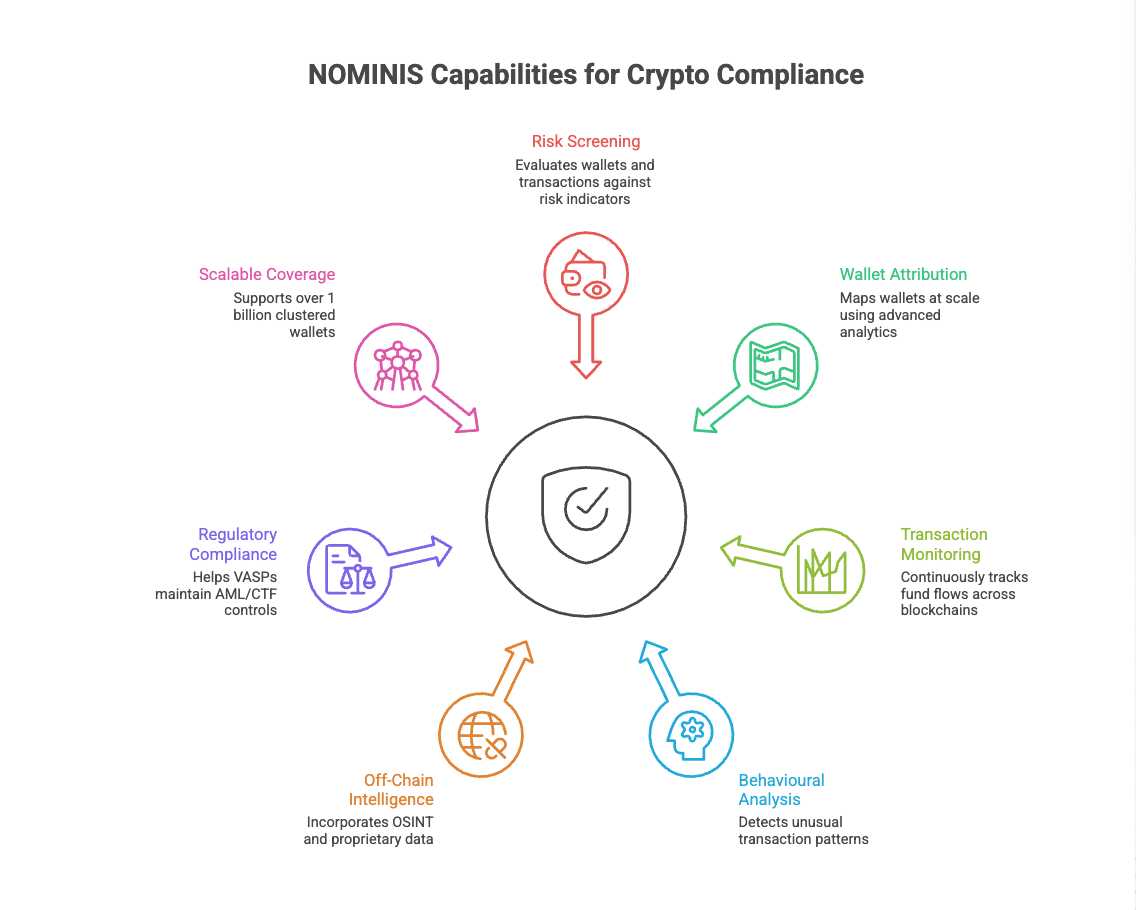
Off-Chain Intelligence Integration:
Incorporates OSINT, regulatory data, media reports, and proprietary sources to provide context beyond what is visible on-chain.
Proactive Regulatory Compliance:
Helps VASPs demonstrate KYT, due diligence and maintain defensible AML/CTF controls.
Scalable Coverage:
Supports over 1 billion clustered wallets, ensuring coverage across the full operational scope of a VASP.
Unique Advantage: The Largest Crypto Terror-Financing Database
One of Nominis’ strongest differentiators is its crypto terror financing database. This is the largest known database of crypto wallets linked to terror financing, including state-sponsored actors, proxy entities, and facilitators and brokers.
Combined with continuous monitoring of fund movement across chains, this database allows VASPs to detect terror and black flag behaviour early, prevent indirect contamination, and perform proactive AML/CTF procedures for regulatory reporting.
By combining multi-source intelligence, behaviour analytics and its specialised terror-financing database, Nominis surfaces risks that traditional forensic tools are not structurally able to capture, providing VASPs with clear, actionable and operationally-relevant compliance goals.
Fit-for-Purpose Compliance
For regulators and investigative bodies, forensic platforms such as Chainalysis and TRM Labs are naturally suitable.
For VASPs however, compliance does not require evidence-grade forensic tools. They require clear, timely, and defensible risk screening.
NOMINIS was built with this reality in mind, delivering purpose-built risk screening, enriched with off-chain intelligence, and designed to meet the operational needs of modern VASPs without unnecessary complexity.
All research content and accompanying reports are provided for informational purposes only and should not be relied upon as professional advice. Accessing these materials does not create any professional relationship or duty of care. Readers are encouraged to consult appropriately qualified professionals for guidance. We uphold the highest standards of accuracy in all the information we provide. For any questions or feedback, please contact us at contact@nominis.io.


.png)