
Warning: This article contains descriptions of sexual assault and exploitation, non-consensual recordings, and other sensitive topics that some readers may find distressing. Reader discretion is advised.
In our previous reports, we uncovered a Chinese Telegram network selling date-rape drugs disguised as chewing gum and other items, and covert recording devices, all purchaseable via USDT.
This final part of our investigation exposes what appears to be the next phase of that same criminal ecosystem: the sale of secretly recorded hotel footage, transforming privacy violations into a profitable, crypto powered enterprise.
Disturbing Extension of the Criminal Network
During the investigation, the Intelligence Team identified a third Telegram group shared in a link by a previous Telegram group, selling the drugs and secret camera paraphernalia. These groups are run by the same individuals, messages from the administrators follow the same structure, tone, offer of customer service, and even emoji use.
Messages from the Hotel footage Telegram group promote the sale of what they call “hotel surveillance footage”, with posts reading:
“Hotel surveillance, every day another rare gem”.
“For more exciting live footage, please place an order yourself to watch the hotel hidden camera stand. Watch online with replay available. Self-service order mail”.

Just like the previous Telegram Groups, the posts contain 24-hour “customer service” contact details.
Another message from the admin read:
“Exclusive videos you can never buy again. Live surveillance you can watch online now - more thrilling, more real 🙈 Hurry up and get on board”
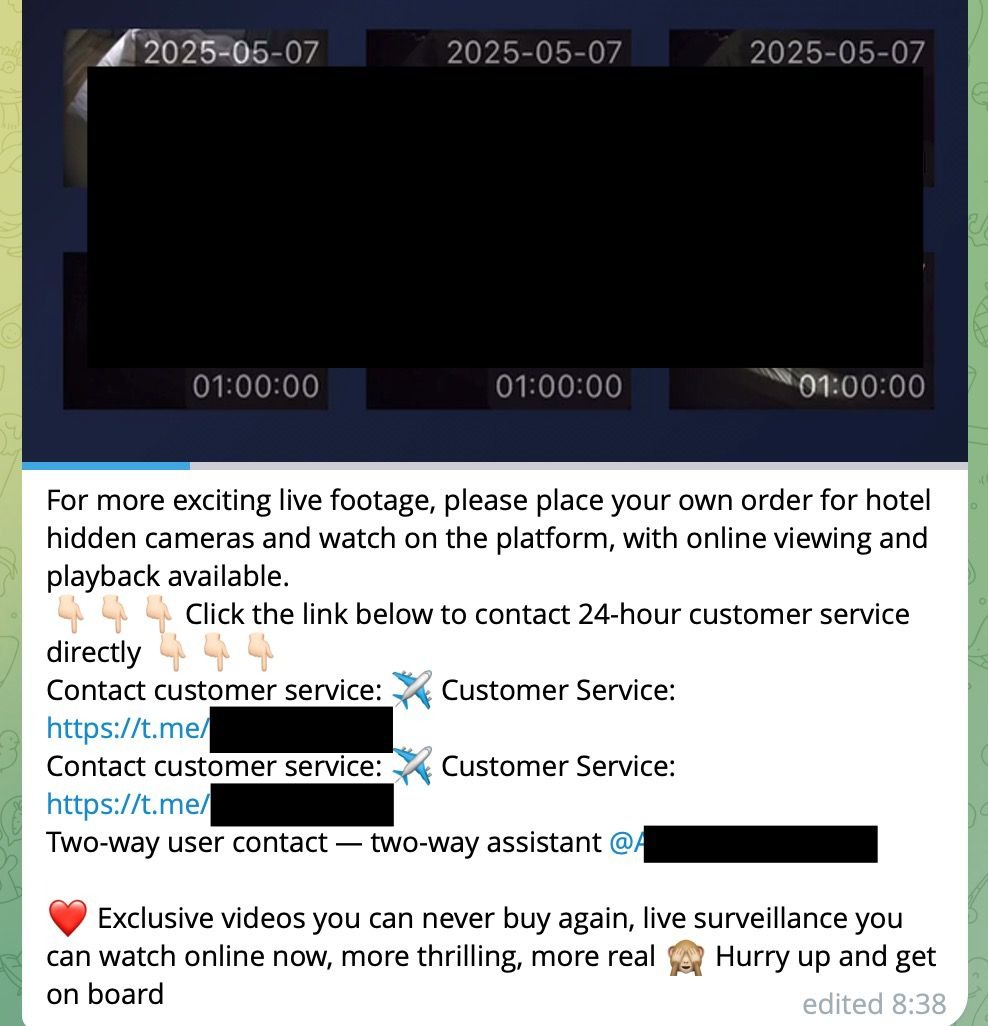
These messages are accompanied by screenshots and thumbnails from explicit recordings, clearly filmed without consent in what appear to be private hotel rooms. The same operators are behind all three channels, using one to distribute surveillance equipment and the other to sell the resulting footage.
In the second Telegram group we investigated, sellers offered a catalogue of pinhole and ‘no-hole’ cameras, marketed explicitly for covert use.
The devices were disguised as everyday objects from wall sockets and smoke sensors to tissue boxes and lighters. Product descriptions boasted features such as ‘no-light night vision’ and ‘remote access’.
When compared with the explicit material promoted in this third Telegram group, selling hotel room footage, the alignment between the two Telegram groups is unmistakable.
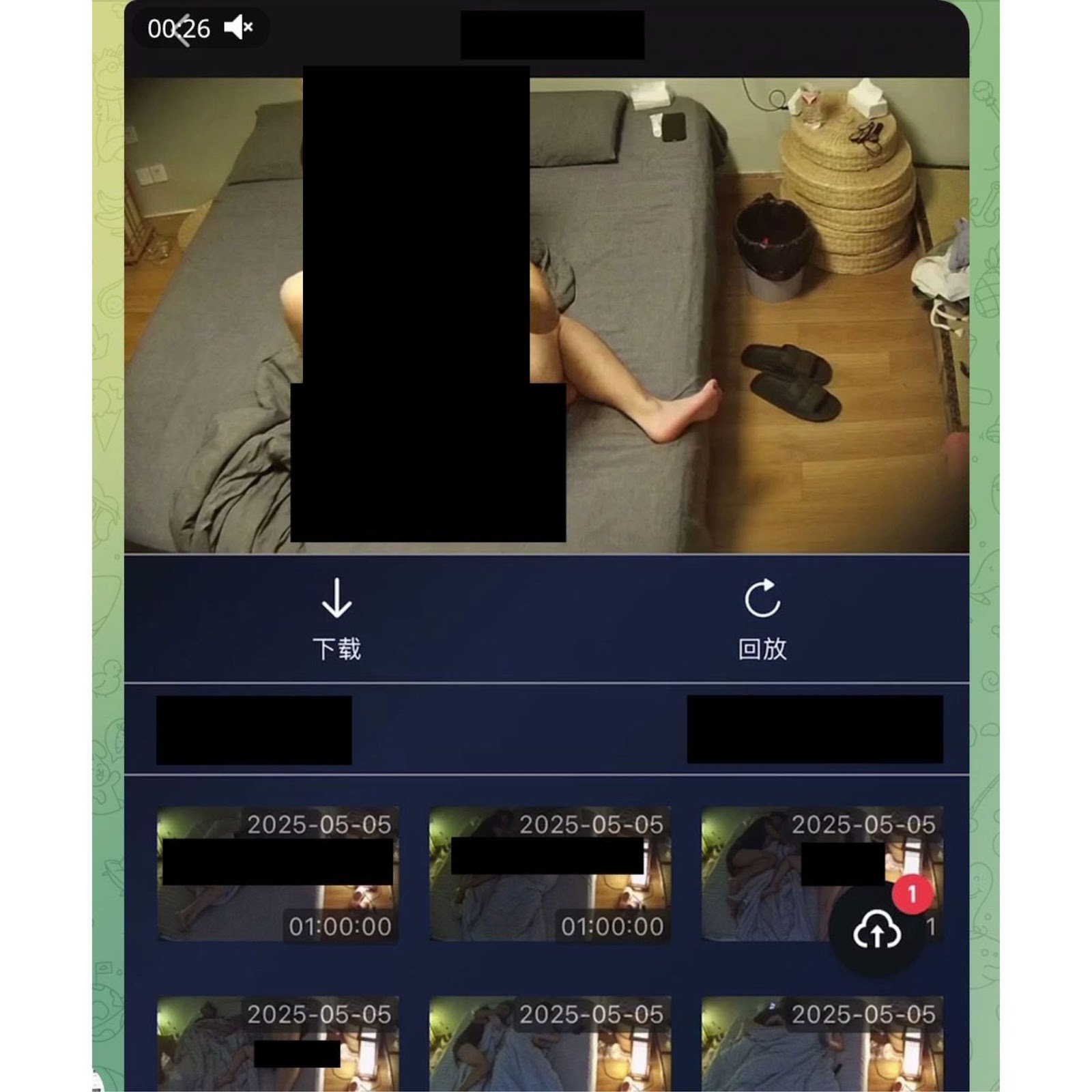
The camera angles and positioning evident in sample screenshots from administrator messages match the kinds of perspectives achievable by devices like those sold in the first group; hidden in corners, clocks, and fixtures typically found in hotel rooms.
This strongly suggests that the same hardware being sold for cryptocurrency is also being used to record the illicit footage later sold for cryptocurrency, closing the loop on an exploitation chain that runs entirely within the Telegram and crypto ecosystems.
The implication is chilling; a self contained economy of abuse where the tools, the content and the payments all flow within a single infrastructure.
From Hidden Cameras to Hidden Economies
The overlap between hardware sellers and footage distributors reveal a disturbing cyclical integration, the same network supplying the means of violation also profits from its output.
The Telegram admins have effectively built a criminal business model:
- Sell the tools of surveillance
- Encourage or facilitate their use
- Monetize the captured footage via crypto payments
- Provide ‘customer service’ to sustain repeat transactions
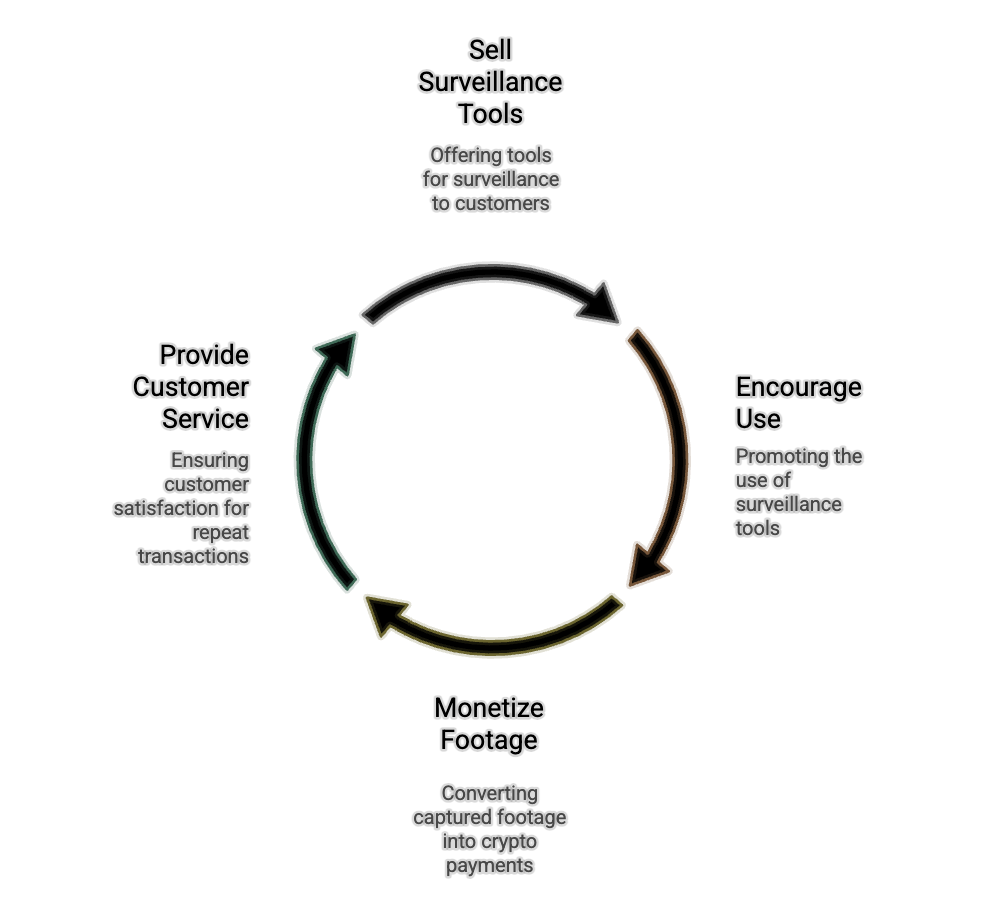
By mimicking the language and structure of legitimate e-commerce, complete with 24-hour support and catalogs, these groups have industrialised privacy invasion, turning real-world abuse into a profitable business model.
Why This Investigation Matters - Connecting Our Three Reports
Across all three parts of this investigation, a coherent pattern emerged:
Part I - The Drugs: A Telegram group openly sold date-rape substances disguised as chewing gum and other items, marketed for ‘making girls obedient’. These drugs remove consent entirely, enabling sexual assault.
Part II - The Devices: The same network offered covert cameras, enabling perpetrators to record victims without their knowledge.
Part III - The Footage: A partner group now monetises those recordings, selling them through a crypto-based “self-service” shop.
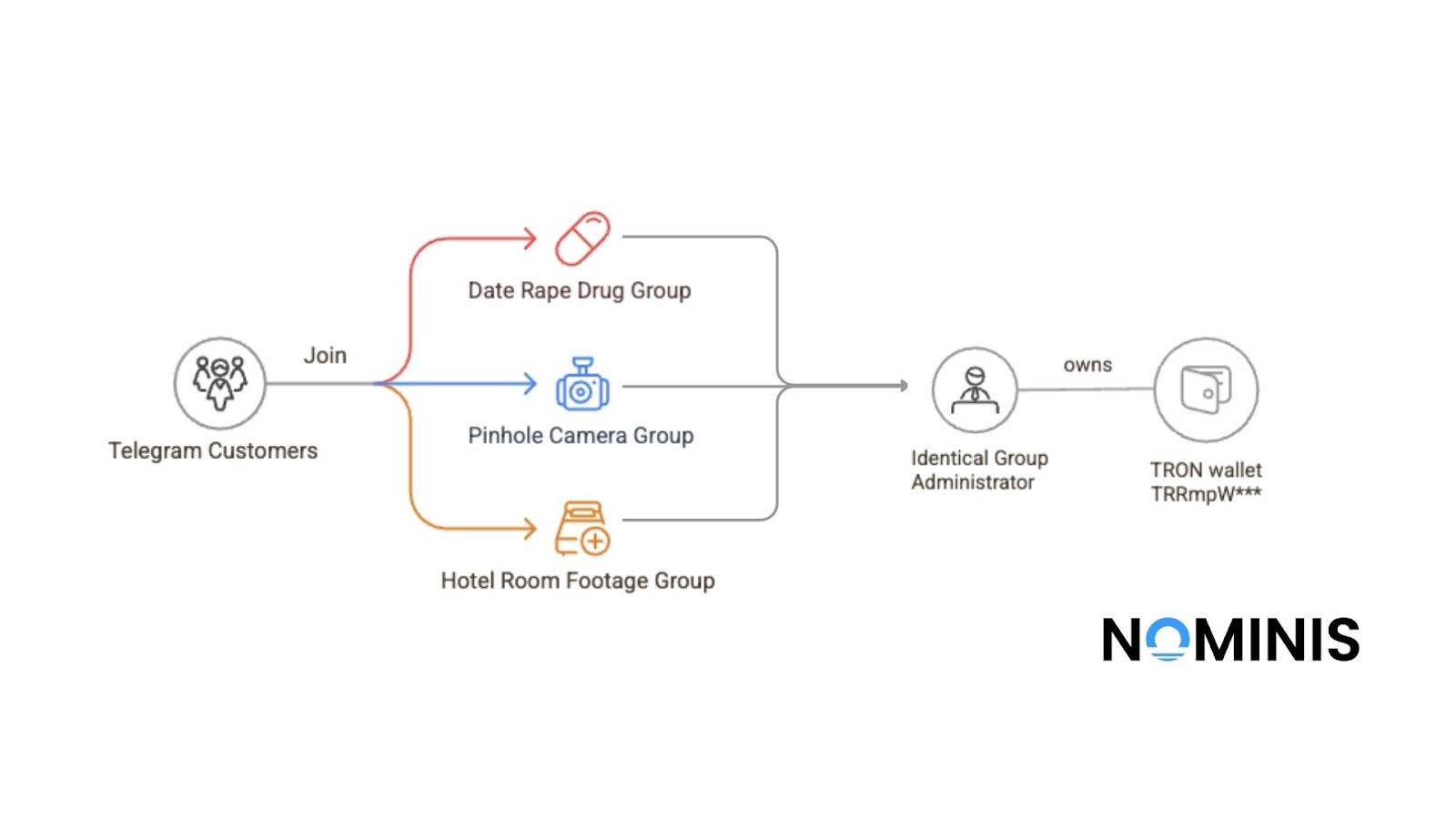
Together they form an interconnected ecosystem designed to facilitate and profit from sexual exploitation, from the chemical incapacitation of victims, to their secret recording, and ultimately the commercial sale of their humiliation.
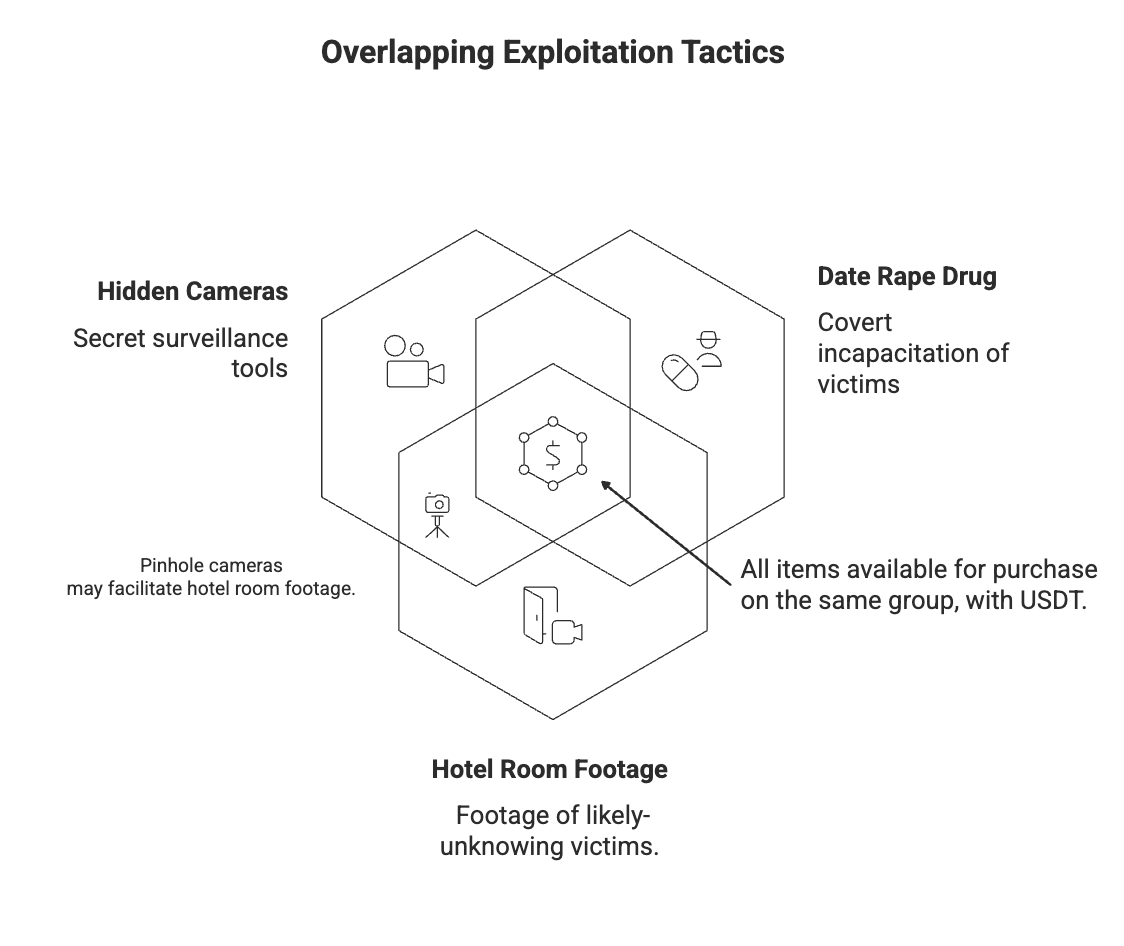
The social cost is vast:
- Erosion of personal safety: When the tools of assault and surveillance are marketed as consumer goods, the boundary between private and public life collapses.
- Cultural normalisation of exploitation: The language of ‘rare gems’ and ‘thrilling live footage’ by the administrator of the group, reframes criminal abuse as entertainment, numbing any kind of moral response.
- Institutional strain: Law-enforcement agencies and platforms struggle to trace crypto transactions and encrypted communications fast enough to intervene.
- Psychological devastation: Victims of both drug facilitated assault and non-consensual recordings face lifelong trauma. Prominent issues among assault survivors include serious mental health outcomes, particularly PTSD and depression, as well as substance misuse disorder. This can be compounded by the knowledge that their abuse is being traded for profit by criminals.
This investigation exposes not only individual crimes, but a systematic alignment of technology, anonymity and opportunism that undermines collective trust in the digital world.
What this means for the Crypto Community
Cryptocurrency sits at the center of each phase of this ecosystem. USDT and other stablecoins are used to purchase the date-rape drugs, buy hidden surveillance hardware, and pay for non-consensual hotel footage.
These transactions demonstrate how easily the same attributes can make crypto powerful; borderless, fast and pseudonymous, can also make it dangerous when exploited by bad actors.
The crypto industry is now arguably at a turning point. Exchanges, wallet providers and payment gateways must acknowledge that preventing money-laundering alone is no longer sufficient; the focus must shift to preventing human exploitation financed through digital currency.
Key actions would include:
- Enhanced on-chain monitoring for wallet clusters linked to illicit marketplaces
- Cross-platform intelligence sharing between exchanges, compliance teams, and law enforcement
- Victim-centric reporting frameworks so that data analysis leads to intervention, not just transaction flags
- Public accountability from stablecoin issuers, ensuring that their assets are not quietly fueling organised abuse.
Crypto has always promised financial freedom, but freedom without responsibility breeds impunity.
The same blockchain transparency that underpins decentralisation can be used to trace and expose exploitation networks if the industry commits to ethical vigilance.
What should happen next?
Our three part investigation reveals a closed-loop system of abuse, all of which is facilitated through encrypted channels and stablecoin payments.
The responsibility now falls on multiple fronts.
Law enforcement must pursue these groups as transnational organised crime. In parallel, regulators and exchanges must tighten compliance frameworks and flag patterns tied to sexual exploitation. These two bodies must work in unison to cease the illicit activity and prevent further victims from suffering.
Meanwhile, technology platforms must act decisively against encrypted marketplaces that commercials abuse, and on a wider scale, society as a whole must reject the normalisation of voyeurism, coercion and commodified violation.
Without unified action, the same innovations that promised decentralisation and autonomy will continue to serve as the infrastructure of exploitation.
This article concludes this Chinese Telegram Group Investigation series. From the sale of chemical agents to the sale of human dignity, these interconnected networks demonstrate how anonymity, technology and crypto can intertwine to erode the foundations of consent itself. Breaking this chain will not merely require law enforcement, but moral courage and systemic reform across every layer of the digital economy as well.
FAQs:
What is this Chinese Telegram Group Investigation series about?
This three-part investigation exposes a connected network of Chinese Telegram groups selling illegal and exploitative products, including date-rape drugs, covert surveillance devices, and non-consensual hotel footage, all paid for with cryptocurrency (USDT).
How are the Telegram groups connected?
Each group features messages from the administrator with mirrored writing style, emojis, and offers of “24 hour customer service” contact details.
The first group sells drugs and hidden cameras, while the second sells secretly recorded hotel footage, likely captured using the same devices. Together, they form a closed-loop criminal ecosystem.
What role does cryptocurrency play in these activities?
Cryptocurrency, particularly USDT (Tether) serves as the financial backbone of this particular network. It enables cross-border transactions, pseudonymity and low friction, allowing sellers to profit while evading traditional financial scrutiny.
Why is the sale of non-consensual footage so harmful to society?
The sale of secretly recorded videos inflicts deep psychological trauma on victims and normalises voyeurism and sexual exploitation as “entertainment”.
It also erodes public trust in private spaces like hotels, Airbnbs, and bathrooms, creating widespread fear and distrust.
All research content and accompanying reports are provided for informational purposes only and should not be relied upon as professional advice. Accessing these materials does not create any professional relationship or duty of care. Readers are encouraged to consult appropriately qualified professionals for guidance. We uphold the highest standards of accuracy in all the information we provide. For any questions or feedback, please contact us at contact@nominis.io.

.png)

.png)