
Is Crypto Replacing Hawala?
At NOMINIS we are frequently asked whether cryptocurrency is making traditional hawala systems obsolete. The short answer is no. The more accurate answer is that modern day crypto infrastructure, particularly Bitcoin’s Lightning Network, reflects principles that hawala has applied for centuries.
Rather than software, Hawala is a trust-based value transfer system that emerged along historic trade routes linking South Asia, the Middle East, and East Africa. Merchants needed to move value without transporting physical cash across dangerous distances, so they relied on trusted brokers, hawaladars, who would make local payouts and later settle balances through trade, commodities, or offsetting obligations. This was relational based, between two parties who had some degree of communications or closeness. Critically, the system was off-ledger.

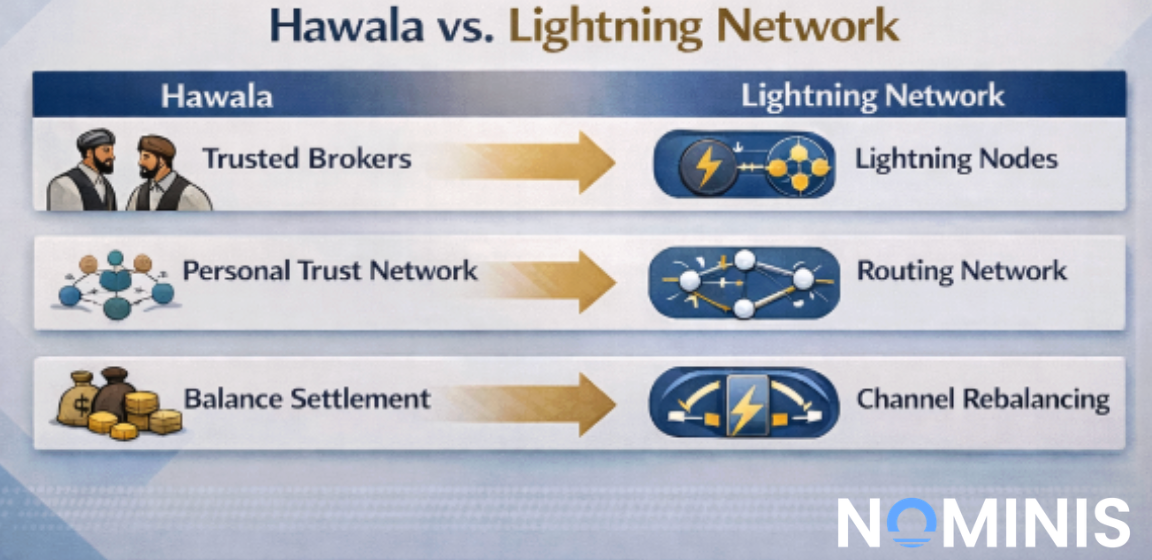
Hawala and the Lightning network are Remarkably Similar
At its core, hawala separates the movement of value from the moment of final settlement.
A customer pays Broker A in one country. Broker B pays the recipient elsewhere. The brokers reconcile their balances later, often through netting, trade or commodity transfers.
Investigations by international financial bodies have repeatedly found that net settlement is the norm in hawala systems, meaning not every transaction triggers a corresponding cross-border money movement. Obligations are accumulated and periodically balanced.
Bitcoin’s Lightning Network follows a strikingly similar structure. Two parties open a payment channel on the Bitcoin blockchain. They transaction privately, and repeatedly, offchain. Only when the channel closes is the final net balance recorded on the main chain. This system works very similarly to expense-tracking applications, such as Splitwise, that have become popular with roommates.
In these systems, the primary ledger is touched only when necessary.
The logic is efficiency through consolidation.
Off-chain Ledgers Are Not a New Idea
Lightning is often described as an innovation that allows Bitcoin to scale. Technically, it is a second-layer protocol that enables fast, low-fee transactions without burdening the base chain. But conceptually, it is an off-chain ledger system layered on top of a primary settlement layer.
Hawala functioned the same way, just without cryptography. Brokers maintained informal internal ledgers. Trust and reputation enforced discipline. Settlement occurred periodically, not continuously.
The difference lies in enforcement.
Hawala relies on social consequence and reputation.
Lightning relies on cryptographic rules and smart contracts.
But structurally, both systems reduce friction by minimizing how often the “main ledger” must be updated.
Hawala Has Always Used Multiple Settlement Rails
There is no single hawala model. Historically, brokers settled balances using:
- Cash balancing
- Trade-based value transfer
- Commodity exchanges such as gold
- Informal accounting offsets
In modern environments, especially where banking access is limited or sanctions restrict formal channels, digital assets can serve as another settlement rail.
Therefore, crypto does not replace the hawala relationship. It simply becomes one of the tools available to rebalance accounts.
Hawala was never defined by its medium, it was defined by its network of trust.
Off-Chain Systems Persist where Formal Systems Struggle
Hawala remains widely used across parts of South Asia, the Gulf, and Africa, particularly within migrant communities sending remittances. It is often faster, cheaper, and more accessible than traditional banking, especially in regions with limited financial infrastructure.
At the same time, hawala networks have been exploited by criminal groups and terrorist organizations seeking discretion or sanctions evasion. Its informal nature makes oversight difficult.
The same dual-use reality applies to digital assets and Bitcoin Lightning. Privacy and efficiency serve legitimate users, but they also create risk when combined with illicit intent.
Neither system is inherently criminal, both are infrastructure, which adapts to whoever uses it.
Today, the Lightning Network has tens of thousands of nodes and thousands of Bitcoin locked into payment channels, facilitating rapid off-chain transfers before eventual consolidation on the main chain. That liquidity sitting in channels mirrors how hawala brokers historically pre-positioned capital to facilitate local payouts before balancing accounts later.
Both systems optimize around the same economic principle:
Move value frequently, settle balances sparingly. So, crypto is not replacing hawala; it is digitizing one of its core mechanics.
For journalists, regulators, and compliance teams, that distinction matters. If hawala is understood purely as an outdated informal practice, its structural influence is missed. If Lightning is seen as entirely novel, its historical precedent is overlooked.
The architecture of trust did not disappear, it simply gained cryptographic reinforcement.
All research content and accompanying reports are provided for informational purposes only and should not be relied upon as professional advice. Accessing these materials does not create any professional relationship or duty of care. Readers are encouraged to consult appropriately qualified professionals for guidance. We uphold the highest standards of accuracy in all the information we provide. For any questions or feedback, please contact us at contact@nominis.io.