In financial investigations, money that moves through complex or opaque structures is often treated as suspicious. However, not all hidden financial activity is the same. Two categories frequently appear similar on the surface but represent very different problems: dirty money and shadow funds. Understanding the difference between them is important for compliance teams, investigators, law enforcement, and organisations operating in digital asset markets.
Dirty Money: Crime as a source
Dirty money begins with crime. The funds originate directly from illegal activities such as drug trafficking, fraud schemes, cybercrime, ransomware attacks, human trafficking, illegal gambling, or other forms of organised crime. The objective in these cases is to convert criminal profits into money that can be used without attracting attention. To achieve this, criminals move funds through multiple layers of transactions, shell entities, financial intermediaries, or cryptocurrency wallets. Each step is designed to weaken the connection between the money and the original crime. For investigators, the central task is to follow the financial trail back to its criminal source. Establishing that link is what enables prosecutions, asset seizures, and disruption of criminal networks.
Shadow Funds: Legitimately directed
Shadow funds present a different challenge. In these cases, the money often originates from activities that are legal at face value. Revenue may come from sectors such as oil sales, commodity trading, state-linked businesses, or commercial companies operating through complex corporate structures. In some cases, funds may also flow through charities, donation networks, or organisations that appear legitimate. At the beginning of the chain, these financial activities may not look suspicious at all. The risk arises later in the process, when money is strategically redirected through intermediaries, front companies, or layered financial routes toward terrorist organisations, sanctioned entities, or hostile state actors. Because the origin of the funds may be lawful, identifying these networks requires a different investigative approach. The challenge lies in understanding how legitimate economic flows are structured and ultimately redirected toward actors that pose security risks.
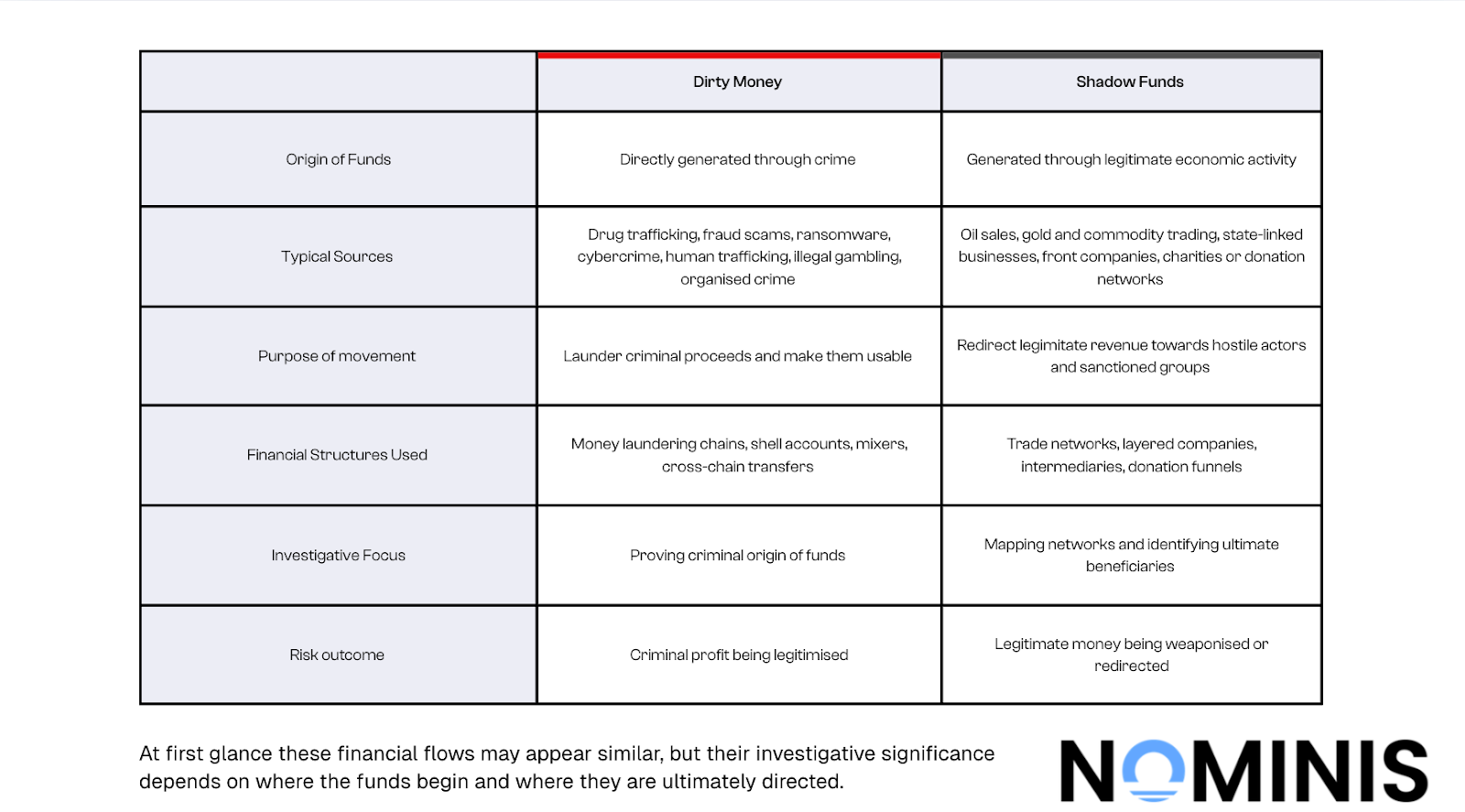
Both dirty money and shadow funds can appear similar when viewed through transaction data alone. Complex routing, cross-border transfers, and multiple intermediaries are common in both cases. This similarity is precisely why investigators and compliance professionals need to look beyond surface complexity and focus on the broader financial context. In dirty money cases, the investigation typically aims to prove the criminal origin of the funds. In shadow funding cases, the key question is how legitimate financial activity is connected to organisations that should not receive those resources.
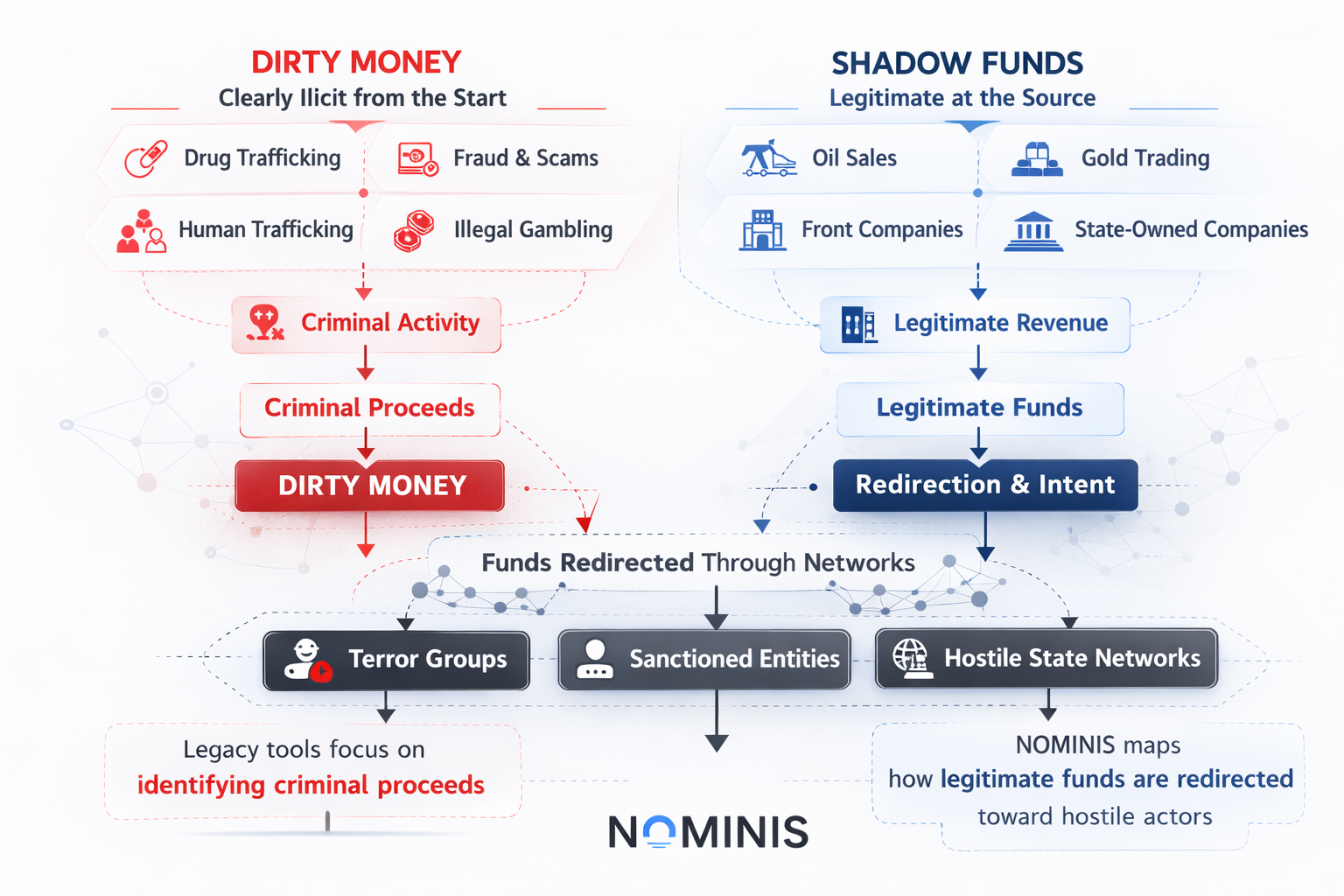
For financial institutions, cryptocurrency platforms, compliance teams, and law enforcement agencies, recognising this distinction is essential. Treating all opaque financial activity as criminal can generate large volumes of false alerts while obscuring the cases that truly require attention. Effective financial intelligence requires understanding both where money begins and where it ultimately ends up. Only by examining the full structure of financial flows can investigators identify whether they are dealing with criminal proceeds or legitimate funds that have been redirected for harmful purposes.


.png)