

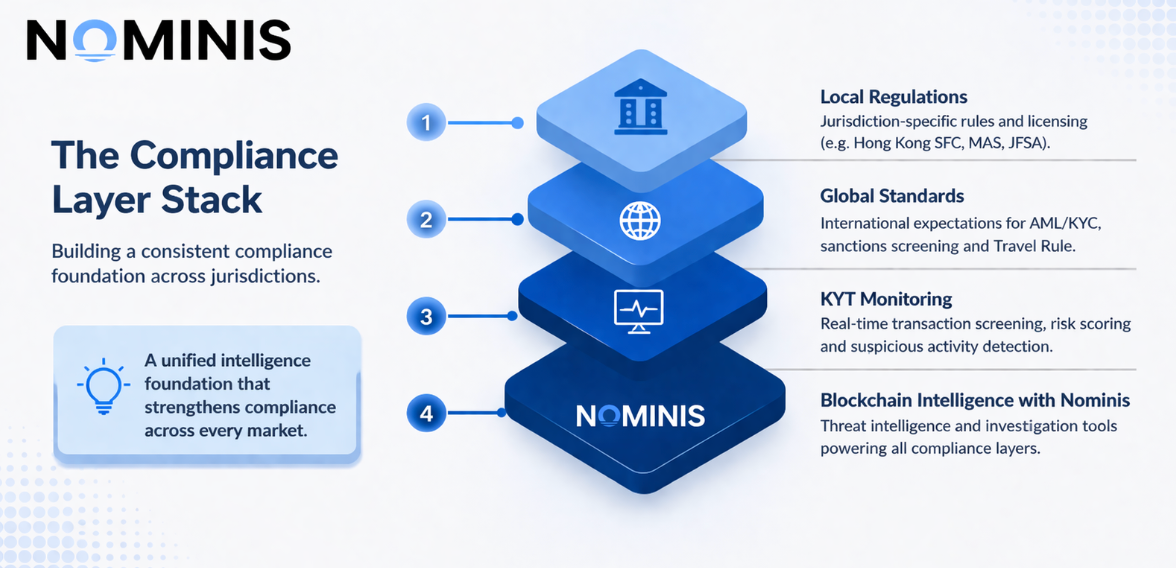
For small and mid-sized crypto exchanges and payment providers, expanding into Asia is increasingly part of the growth strategy. But while the opportunity is clear, so is the challenge. Across jurisdictions such as the Monetary Authority of Singapore, Securities and Futures Commission of Hong Kong, Financial Services Agency of Japan, and Securities and Exchange Commission Thailand, expectations are clear: continuous transaction monitoring, risk-based controls, and the ability to explain decisions.For exchanges and payment providers, this often becomes a question of compliance infrastructure: how do you choose a transaction monitoring system that actually works at your scale?
1. Enterprise-Level Expectations, SMB-Level Resources
Regulatory expectations don’t scale down, regardless of the size of the business. Smaller exchanges and payment platforms are still required to implement continuous monitoring and maintain robust AML controls. The challenge is that many legacy platforms are built with large enterprises in mind, complex to deploy, resource-heavy, and difficult to manage by an in-house compliance person or team. This is where a more lightweight API driven approach becomes more important. NOMINIS’ platform is designed to integrate directly into existing systems without heavy operational overhead, allowing smaller teams to meet regulatory expectations without building out large compliance functions. Built with SMBs in mind, NOMINIS delivers high-quality transaction monitoring designed to scale with growing teams.
2. Alert Volume Overwhelms Small Teams
High alert volumes remain one of the most common operational bottlenecks.Many systems generate large numbers of alerts with limited prioritisation. For SMB teams, this quickly leads to alert fatigue, where investigators spend more time filtering noise than assessing real risk.A more effective model is to reduce noise at the source. NOMINIS takes this approach by focusing on fewer, more meaningful alerts - ensuring that what surfaces is already prioritised and actionable, rather than adding to the backlog.
3. Lack of Context Slows Decision-Making
On-chain data alone is rarely sufficient to assess the true risk of a wallet. Without additional context, decision-making becomes slower and inconsistencies can emerge across cases.By incorporating a wide range of off-chain intelligence, including deep and dark web sources, social media intelligence, geo-intelligence, and behavioural patterns, NOMINIS provides a more complete view of risk. This allows compliance teams to make more consistent, well-informed decisions with confidence, with a clearer understanding of who and what sits behind each alert.
4. Black Box Scoring prevents transparent explanations to the regulators.
As regulatory expectations increase, the need for transparency does too.
Many tools rely on opaque scoring models, where risk is presented as a number without clear justification. For SMBs, this becomes a real issue during audits or regulatory reviews, where decisions need to be explained and defended.To combat this, NOMINIS provides transparent, explainable risk scoring, where each alert is supported by visible data points and reasoning, making it easier to validate and communicate decisions with confidence.
5. Isolated Alerts Make It Hard to See the Bigger Picture
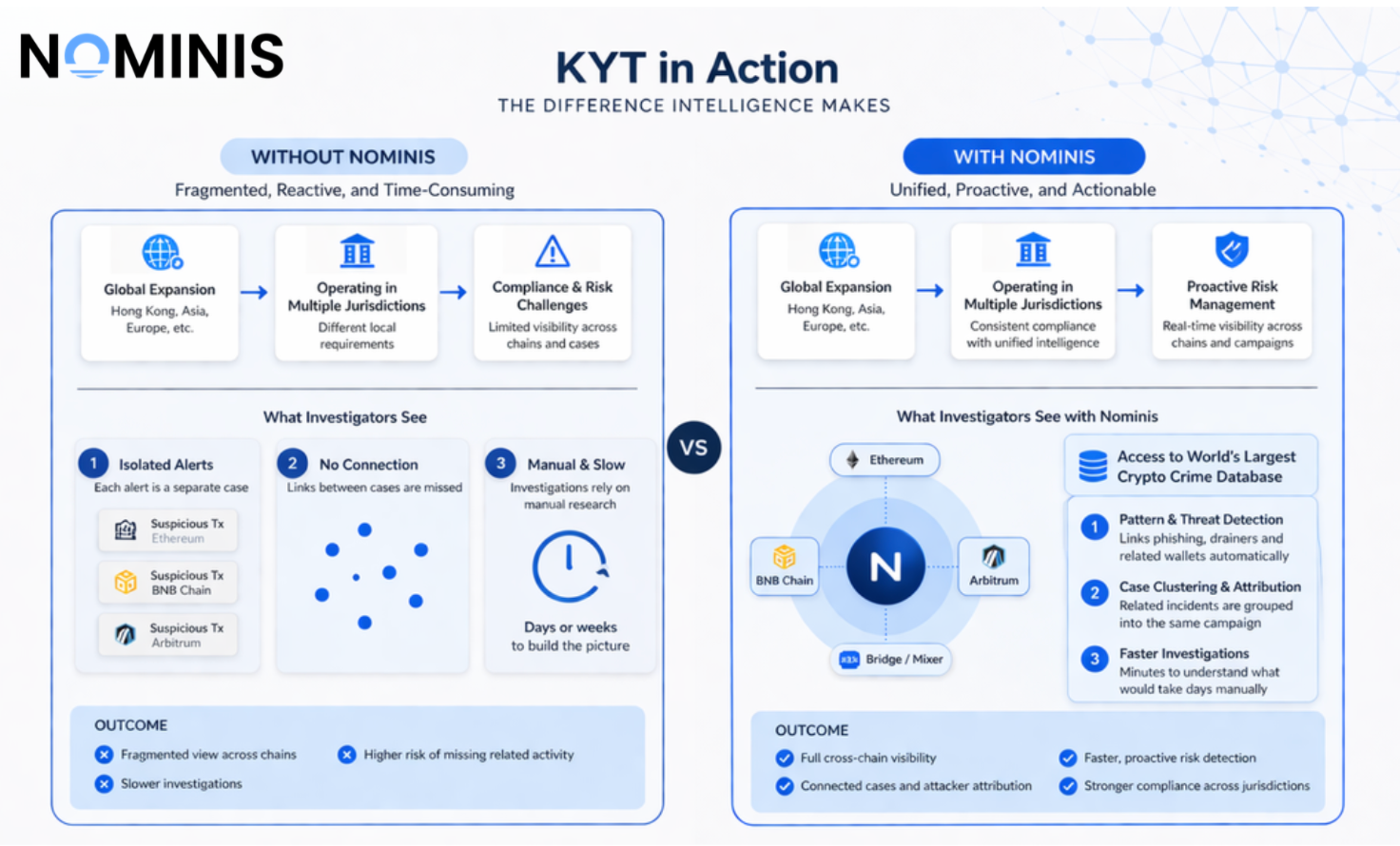
Modern financial crime is rarely made up of single, isolated transactions. Phishing campaigns, wallet drainers, and mule networks often involve groups of wallets, repeated behaviours, and shared infrastructure. When alerts are treated individually, these patterns are easy to miss, or take too long to uncover. NOMINIS addresses this through clustering and entity-level analysis, linking related wallets, transactions, and behaviours into a single view. This allows teams to move beyond isolated alerts and understand activity as part of a broader pattern, making detection faster and investigations more efficient.
Final thoughts
The expansion of crypto exchanges and payment platforms into Asia reflects a broader shift toward a more global operating model. With that shift comes the need for compliance infrastructure that is not only robust, but also scalable for smaller teams. Transaction monitoring sits at the centre of this, but its role is evolving, and it is no longer enough to simply flag activity or generate alerts at volume. For SMBs, the challenge is more specific: meeting enterprise-level expectations without enterprise-level resources, managing alert volumes without creating fatigue, and making consistent decisions without relying on incomplete data or opaque scoring models. At the same time, there is a growing need to bring together a wider range of intelligence and to move beyond isolated alerts, toward understanding patterns across activity. What matters now is the ability to understand risk clearly, through manageable alert volumes, meaningful context, transparent scoring, and connected insights. For compliance teams, the focus is increasingly on clarity over complexity, context over scores, and actionable insight over noise.
All research content and accompanying reports are provided for informational purposes only and should not be relied upon as professional advice. Accessing these materials does not create any professional relationship or duty of care. Readers are encouraged to consult appropriately qualified professionals for guidance. We uphold the highest standards of accuracy in all the information we provide. For any questions or feedback, please contact us at contact@nominis.io.

.png)

.png)